For more than a decade before the outbreak of the American Revolution, the marriage between Great Britain and her English Colonies in America was in crisis. The Stamp Act, Townshend Acts and Tea Act were all triggers for English Colonists, who, as emigrants of the Crown, still somehow wanted all the same perks and homecourt advantages of home.
The Boston Tea Party and Massacre led to the Coercive Acts, and in response a group of thought leaders including George Washington, John Adams and others met in Philadelphia to levy their grievances to the Crown. In their “Declarations and Resolves of the First Continental Congress” they outlined 12 talking points which began:
October 14, 1774—The inhabitants of the English Colonies in North America, by the immutable laws of nature, have the following RIGHTS:
Resolved, N.C.D. 1. We are entitled to Life, Liberty, and Property.
It was the first time that particular phrase appeared in American nomenclature, and, in addition to building out their original 13 Colonies, America’s founders and future leaders were tasked with creating marriage laws, too.
While states draft and regulate their own marriage laws, each unique in their own particular way, there are 1,138 federal statutes that oversee the nation’s marriages in terms of benefits, rights and privileges, according to the United States Government Accountability Office.
Considered a “fundamental right” by the U.S. Supreme Court in 15 different opinions, the federal government now intercedes to legislate the affairs of married, divorced, even widowed spouses on everything from social security > pensions > survivor benefits > tax-free transfers > and income tax. But is the federal government’s oversight rewriting state marriage laws?
The 1996 Defense of Marriage Act (DOMA) prohibited the federal government from recognizing same-sex couples who were lawfully married in their state. A conflict between DOMA and the Due Process Clause of the Fifth Amendment led the U.S. Supreme Court to rule DOMA unconstitutional (United States v. Windsor). Moreover, its precipitated and ultimately legalized same-sex marriage as the law of the land (Obergefell v. Hodges).
When women married in Colonial America, they had rights but no autonomy. They found themselves in positions of almost total dependency on their husbands which the law called “coverture.” English jurist William Blackstone describes the legal atmosphere of marriage in 1765 in the “Commentaries on English Law:”
By marriage, the husband and wife are one person in the law: that is, the very being or legal existence of the woman is suspended during the marriage, or at least is incorporated and consolidated into that of the husband: under whose wing, protection and cover she performs.
While the Thirteenth Amendment emancipated the slaves, it was the subsequent Civil Rights Act of 1866 that acknowledged their right to marry.
After emancipation, freed people were permitted to make their unions legal by applying to their state for marriage licenses. On March 3, 1865, an Act of Congress established the Freedmen’s Bureau and published an announcement in a politically progressive biweekly magazine called "The Nation:"
Any couple who appears before a Justice of the Peace, or Clerk of the Court, and states when they began living together as husband and wife, will be issued a certificate and considered lawfully married, retroactively.
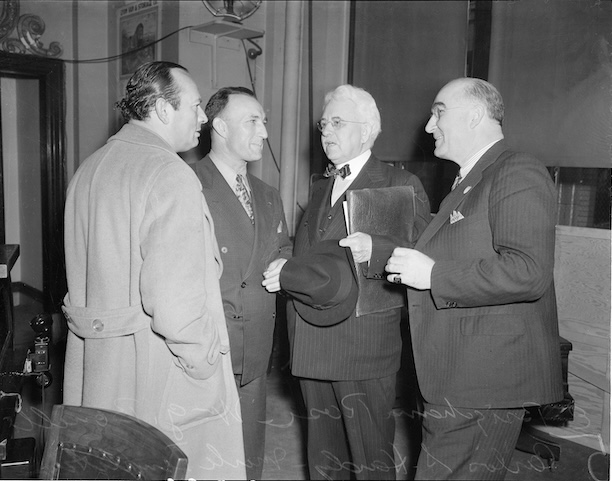
Bonelli (second from left) at trial with others 1939.
Though he failed to substantiate his libel suits with the LA Times and Mirror, what he left behind was a rather infamous reputation as California’s “Liquor Czar.” Using Bonelli’s own words, Katcher opened with the first indictment of fake news in the 20th century:
Like a Captain’s Tower at First and Spring Streets in Los Angeles, there sits today the third in line of financial and political kings who have ruled Southern California for almost three quarters of a century. He's a shadow man, virtually unknown to the six million people whose government and livelihoods are shaped by his desires.
Forget that FB and X aren’t fact checking posts anymore, the new and improved “Community Notes” now taking their place, this was the first direct accusation by a government insider with exculpatory evidence linking the owners of the Los Angeles Times and the Los Angeles Police Department to king-making, union busting, subverting laws, violating civil rights, and in Bonelli’s own words: "aligning class against class, race against race, in an attempt to make bigger profits for themselves.”
An alumnus of the prestigious University of Southern California; lettering in varsity tennis, football and basketball; serving as a pilot in World War I; claiming a seat in the Los Angeles City Council; subsequently the California State Assembly; and commandeering the State Board of Equalization ensured that at 5 feet 8 inches tall only Big Bill Bonelli coming in at 190 pounds had full and complete authority over California’s liquor licensure during and following the Prohibition era. When Bonelli, 32, was named President of the Los Angeles City Council District, his inaugural address began, “Let us use our efforts to prevent the LAPD from being swayed from its duty by outside control.”
The 21st Amendment to the Constitution was ratified in December 1933, whereupon President Franklin D. Roosevelt proclaimed the end of Prohibition. The 21st Amendment gave states and local governments the responsibility for regulating alcohol, and after nearly a century here's where the nation’s habit stands today. According to the National Institute of Alcohol Abuse and Alcoholism:
The national annual per capita consumption level of 2.51 gallons of ethanol equates to every person aged 14 or older consuming an average of 535.5 standard drinks per year.
If Prohibition was driven by a combination of social, economic and religious factors, Bonelli understood the politics. His father, George Bonelli, and his ancestors had effectively settled Kingman, Arizona: operating commercial real estate at the epicenter of a 250,000 acre ranch. A Temperance Movement — linking alcohol with domestic violence, poverty, illness and crime — grew out of these rural areas; drawing the attention of politicians to regulate the nation’s behavior and protect the American Way.
Like his father, Bill Bonelli’s ranch, stadium, movie studio and rodeo come speedway in California drew record crowds to his innovative Bonelli Tracts. The Santa Clarita Valley was an outpost when he began developing the infrastructure of suburban sprawl some 36 miles north of Los Angeles. Today, over a quarter million people reside in what the LA Times rather ironically confirms is amongst the “Best Places to Live in the U.S.”
Of note. While serving as President of the Los Angeles City Council, and later California State Assembly, Bonelli somehow found time to moonlight as an Associate Professor of Political Science at Occidental College. Flanked by the most prestigious liberal arts colleges in the United States, Bonelli’s contribution to Oxy’s politics major was the curriculum’s combination of rigorous in-classroom work combined with community-based, experiential learning opportunities.
Under Bonelli, political science majors at Oxy received internships through the Center for Community Based Learning (CCBL); which provided human services for the Indigenous Peoples’ in Los Angeles County. Herewith, his biographer Leo Katcher speculates as to why.
There was an innovative passive air-conditioning system built into Bonelli’s childhood home. A cupola, conducting warm air up and out of the rooftop, was in its day an engineering novelty, but the decorative twenty-four panes of glass framing a four point arched roof was designed as a lookout.
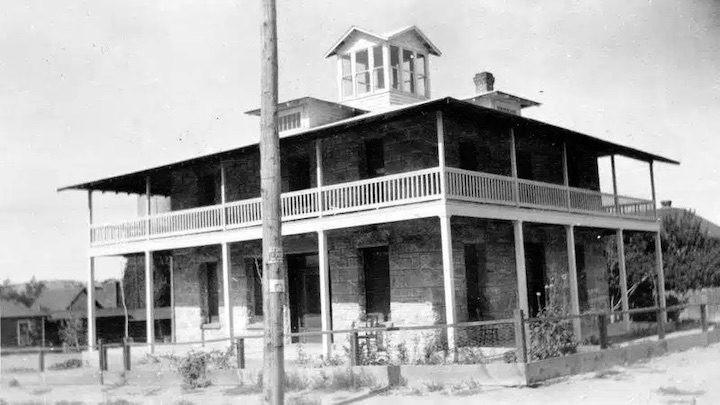
Bonelli House circa 1915.
At the dawn of the 20th century, the Bonelli boys would climb the stairs to their “Captain’s Tower” at Bonelli House and play Blackjack. It was a crow’s nest whereby they could see all they surveyed; somewhere beyond Mohave’s county seat or a township they purveyed; onto surrounding sovereign nations and American Hualapai for whom Bill, and brother Frank, cooked for and befriended in the Gilded Age.
That the Indigenous Peoples’ were dying from historical trauma — at 11% the national average from alcohol consumption — belies the gains the world has made by 2025. According to the World Health Organization (WHO), around 2.6 million people die from alcohol consumption each year via injuries, alcohol poisoning, cardiovascular conditions, mental health problems, and now, apparently, cancer.
That we drink to induce euphoria or reduce anxiety implies a choice: double down, or choose a path to renewal. Somewhere beyond the Mohave's lime rock light, we believe Bonelli saw and chose the road less taken.

All the World’s a Stage
Make sense of the week's news.
Charlatan reviews the worldview.
CHARLATAN
The Exposé of Politics & Style