The Merry Widow
As the holiday lights up the nation, Charlatan follows a widow’s second act to a command performance and encore of the season.
29 November 2026
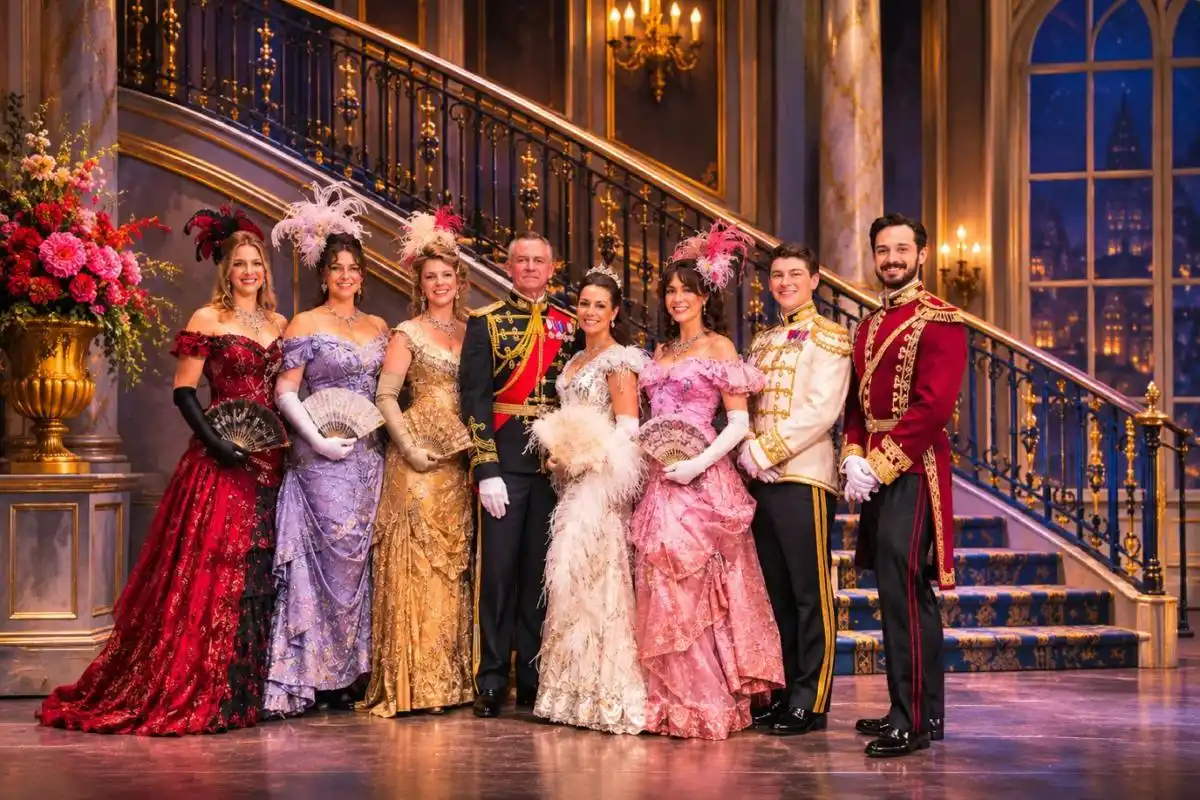
Act I: Providence Road
While prospecting the house of pale cream-colored stone on Providence Road, she foresaw her young daughter, Hayden, descending the grand staircase on her future wedding day. That her fantasy never bore fruit didn’t factor into the young couple’s financial decision to invest on the fringe of the elitist enclave, anyway. And that it stood on the very same street as her childhood apartment building belied the middle-class neighborhood into which she was born. In Charlotte, North Carolina, a mere country mile on a Mecklenburg County road can divvy up Martin Luther King’s American dream from “The Other America.”
After 25-years, an ideal American family emerged complete with a breadwinner of 30 years at IBM investing generously in a 401(k), private schools, luxury cars, second homes, and expensive summer vacations all chronicled on social media and crowned in glory by the achievements of three children who went on to attend Public Ivies and Ivy League schools. At the helm was her first-generation American husband, a buttoned-up, morally upright European prince of a man, and the Czechoslovakia of yesteryear his family had left behind. The American social ideal that stresses egalitarianism, material prosperity, and upward mobility is pronounced in James Truslow Adams “The Epic of America:”
A dream of social order in which each man and each woman shall be able to attain to the fullest stature of which they are innately capable, and be recognized by others for what they are, regardless of the fortuitous circumstances of birth or position.
For both the 1922 Pulitzer Prize winner, and our protagonist’s family, that simple dream enshrined by the Declaration of Independence was increasingly at risk across the expanse of the American century.
Though her husband’s death presaged the early hours of Covid-19, then little more than faint news alerts from faraway places, she realized in the weeks preceding his passing that facing the crisis would require acknowledging that class struggle. Not by making peace with its injustice, but by remaining defiantly maladjusted to it.
Her high school senior inquired several weeks after the funeral. “Are we going to be ok?” Cole asked his mother. “I calculated how much I can make at ‘Pasta and Provisions’ if I quit rowing and work as much as I can after school.” Teenager Grant reassured his mother on many occasions, too. “Don’t worry. As soon as I am able, I will take care of you.” Even daughter Hayden assigned herself a partner or companion in her mother’s grief, divvying up the rigors of adolescence with her service to the widow.
Over three million people died in the United States in 2024, according to the Centers for Disease Control and Prevention (CDC), led by heart disease, cancer, and unintentional injuries. In the aftermath of her husband’s passing, a cast of rather chivalrous characters presented themselves to carry on their American dream. Widowhood, however, would require more practical arithmetic.
Women earn about 83 cents for every dollar paid to men, according to the Bureau of Labor Statistics. They outlive them, too: 81.4 years against 76.5, according to the CDC. Past the age of 75, about 58% of American women who have married are widows, compared with 28% of men, according to the Census Bureau. By these numbers, the hour doesn’t simply draw nigh. It is a patent inevitability. The majority of women in due course will face the world alone.
What was her late husband’s legacy? Could or should she ever love again? Would someone new — more than kin and less than kind — disrupt who they were, and how they got from one day to the next? Behind each question lay a cue, bell, chime, and horizon line toward Bali.
Act II: 60th and First
That an engineering degree, an MBA from Stanford, and résumé built on commodities, emerging markets, and complex, high-value transactions didn’t sync with his seemingly warm and kind demeanor was an observation that Cole would remind himself and others on more than one occasion. “I can’t reconcile the man with the résumé,” he’d say, which on reflection summed up their whirlwind romance.
The CEO for a Global Corporate Investment Bank over the Americas, her new suitor’s corporate apartment on 60th Street and 1st Avenue dwelled in a kind of extra-terrestrial twilight. Above the restless geometry of Manhattan, the Queensboro Bridge stretches across the East River to Queens, home to middle-class immigrants still chasing a better life, coexisting with a trail of broken hearts systemically marginalized by the institutions of America. The architectural wonder requires a hefty toll to pay for the jobs, equity, and inclusion promised by the American dream.
Her pediatrician had introduced them. A divorced father with three grown daughters, his former marriage of 27 years sounded less like a reflection than an account, albeit over a safe lunch. A natural improv eclipsed the forced script of a first date and drew them together from the off. Only about half of all first marriages in the United States ever reach their 20th anniversary, according to the CDC. Yet the gentleman who’s been unhappy in marriage and marries again, the lexicographer Samuel Johnson said, makes remarriage “the triumph of hope over experience.” Just like King, who after a hundred years of broken promises to Black Americans still dared to dream.
Still, the prospect of second marriage grows increasingly remote with age. Nearly one in four marriages in 2023 was a remarriage, according to the National Center for Family & Marriage Research, though the likelihood of remarriage diminishes ever more considerably with advancing years, particularly among women. For widows, the calculus is perhaps more complicated still. A lifetime of love, loss, children, property and accumulated memories hardly invites the prospect of beginning again, much less surrendering the independence of widowhood. Yet at the moment of decision the universe conspires to assist, if under the guise of a second date.
“Until one is committed there is hesitancy, the chance to draw back, always ineffectiveness,” the Scottish mountaineer W. H. Murray wrote of his 1950 Himalayan expedition, before quoting a couplet he credited to Goethe’s Faust: “Whatever you can do, or dream you can, begin it.”
A meditation workshop in Indonesia presents our scene, and a multi-stop, connecting itinerary to the Emerald of the Equator a plot of her own conceit. Demurring from the invitation to stay with her suitor in his penthouse, she opted instead for a relatively inexpensive hotel quite conveniently near his Bridge Tower Place. And it was there, in an inaccessible wilderness called the Central Park, where it began…
A second love she hadn’t planned.
The Angel holding up her hand,
two coats, a bench, the fountain dry,
as if to stop the falling sky.
They’d each been married to a life,
someone’s husband, someone’s wife.
The leaves came down like paid-off debts;
they’d settled up with their regrets.
She said Ramble, he said Mall;
they took the long way, after all.
At sixty-some, the heart moves slow,
it knows to where the river flows.
Their second date, merely a contrived stopover enroute to Bali, belied the month ahead: teaching mindfulness at a foundation school in Tulamben, Indonesia. Hayden, her de facto partner in grief, was interning there and had summoned her mother to the experience. On an island of Hindu temples, yoga comes from the Sanskrit yuj, “to yoke” or “to unite” the self with reality. Stilling the mind’s fluctuations is the workshop. Liberation is the final scene.
Act III: Tat Twam Asi
In her second week, she asked Ketut, who ran the school with his wife, Wayan, whether a practice she taught American children would translate here. His answer: "Tat twam asi." Twenty minutes later, Ketut fell from a mango tree.
Blood pooled beneath his head as his wife held his face in her hands. Wayan was losing her husband and Angela recognized herself in their story. Suddenly, a stage cue:
Tat twam asi: "I am you, and you are me."
The yogis' union and Ketut's words were the same idea in two languages. Wayan's husband survived. Her first husband did not. Neither outcome was in their control; what was, was how they met it. And John stood somewhere between the two, untested.
What she carried home was the practice: to look at what is—and act. "If you're worrying something will happen — don't let it," her first husband often said. His words were a call to action. A reminder to get to work. She called them "eureka moments" every time he said them, and like a boy who saves a seat for his friend on the school bus every single day, so too comes a benefactor some forty years on who now pays Hayden's college tuition in her father's absence.
After a month in Bali, she will return home; connecting first in New York for another look at the Queensboro.
Epilogue
She looks with brown eyes through a floor-to-ceiling plate glass window upon an island built upon metamorphic bedrock, rubble and trash. Neither a full-time resident, nor a visitor to the city, she dwells amongst 12.5% of American newlyweds who’re “Married and Living Apart Together” (NCFMR).
All long-distance courtships, and star-crossed lovers, eventually meet their fate in reunions. Distance makes the heart grow fonder, whilst simultaneously sidestepping the reality of everyday life. As a rite of passage, they’ve already carried their vows to Paris, where Lehár set his merry widow loose among embassy balls and champagne-lit suppers at Maxim’s. Over a century on, the operetta set in the City of Light continues to play across Europe.
That she presides from Bridge Tower Place on the Upper East Side of Manhattan over Queens belies a realization that she now belongs to both. “I cannot imagine living here full time,” she says, “but now can’t quite imagine life without it.”
How a first-generation American passed the baton to a prominent CEO for a Global Corporate Investment Bank required Radical Acceptance: It’s the yogis' “union;” Ketut's “tat twam asi” (I Am You, You Are Me;) King's “beloved community,” and the errand of a babe in Bethlehem. All of whom in life remained defiantly maladjusted to what the world ought not to be.
John appeared to her consciousness before the leaves turned brown, and their days above the Queensboro will soon reconcile with the jubilee of retirement. Renovations to their new split-level ranch in Charlotte will in time accommodate their blended family—if with a staircase that now ascends only half-a-flight.
She began by envisioning an American dream, until the Eternal Feminine, and the redeeming power of love and grace, drew the cast into a command performance and encore on high. Christmas is drawing nigh, and with it a reminder about second chances.
Lips are silent, the widow sighs, but the violins sing of love.