CHARLATAN
The Exposé of Politics & Style

A veterinary toxicologist calls it the largest mass pesticide approval he has tracked in years of watching the agency. No one else called it anything, because no one else was told.
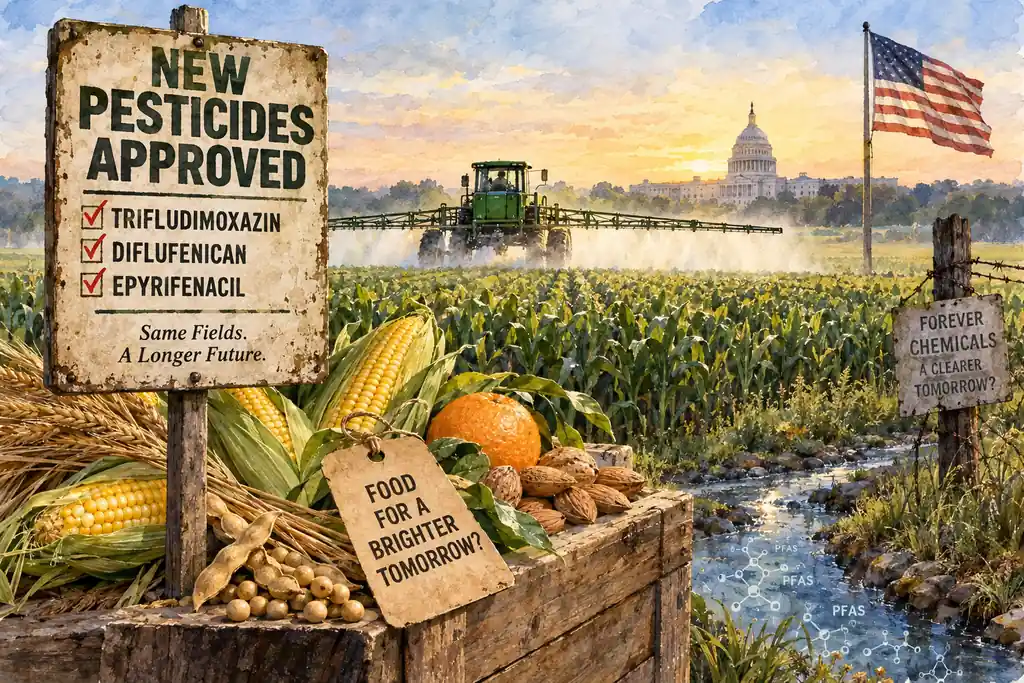
The three chemicals — trifludimoxazin, diflufenican, and epyrifenacil — were approved in a single day, June 30, 2026. Combined, they're now cleared for use on corn, soybeans, and wheat — the country's most heavily planted acreage — along with citrus, peanuts, almonds, oats, and canola, depending on the compound. They bring the total number of PFAS pesticides approved under the current administration to five, alongside expanded uses for two existing ones, bifenthrin and chlormequat.
EPA's own scientists flagged trifludimoxazin as showing "suggestive evidence of carcinogenic potential," based on thyroid tumors observed in animal studies, and found it will break down into twelve separate PFAS compounds once released into the environment.
Epyrifenacil produced liver and blood effects in animal studies. Diflufenican breaks down into a compound structurally similar to aniline — which the EPA itself classifies as a probable human carcinogen — and, alongside epyrifenacil, into trifluoroacetic acid, already one of the most pervasive PFAS contaminants in groundwater worldwide. The EPA maintains the labeled use restrictions are sufficient to protect human health, and says the approvals "do not pose unreasonable risks to human health or the environment." The American Farm Bureau Federation welcomed the decision; its president, Zippy Duvall, thanked the agency for "additional tools to manage increasingly difficult weed pressures."
None of this counts as a PFAS approval, according to the EPA, because in 2023 the agency narrowed its own definition of the term to chemicals containing two or more fluorinated carbons. All three new pesticides are built around a single fluorinated carbon. By the EPA's redefined standard, they are not PFAS. By the OECD's internationally recognized standard — one fully fluorinated carbon is enough — they are. An EPA spokesperson has said the products "are each single-fluorinated-carbon compounds. By the prior administration's own regulatory definition, they are not PFAS." That defense is accurate and also beside the point: the prior administration wrote the definition; this one is the first to use it this way.
"This is the PFAS presidency," said Nathan Donley of the Center for Biological Diversity, "brought to you by Donald Trump and EPA Administrator Lee Zeldin."
To understand the weight of that decision, it helps to understand the chemical whose legacy hangs over it: glyphosate.
Discovered by accident in 1950 by a Swiss chemist searching for pharmaceuticals, glyphosate sat unused for two decades until a Monsanto chemist identified its herbicidal power in 1970. Monsanto brought it to market as Roundup in 1974. It stayed a conventional weed killer for twenty years — until 1996, when Monsanto introduced Roundup Ready crops engineered to survive being doused with it directly. Use climbed roughly fifteenfold. More than 280 million pounds of it are now sprayed across nearly 300 million acres of American farmland every year.
The safety question was contested from the start. An EPA panel classified glyphosate a possible human carcinogen in 1985 after kidney tumors appeared in exposed mice; Monsanto challenged the finding, and by 1991 the EPA had reversed itself. In 2015, the World Health Organization's cancer research arm classified glyphosate as probably carcinogenic to humans. The EPA and European regulators still disagree with that finding — a genuine scientific dispute, not a settled one. The dispute never resolved in a lab. It resolved, for a while, in court.
Juries in San Francisco, Oakland, and federal court awarded plaintiffs hundreds of millions and, in one case, over two billion dollars in Roundup-cancer verdicts between 2018 and 2019 — later reduced on appeal, but not overturned. Bayer, which had acquired Monsanto in 2018, paid more than $10 billion in 2020 to settle roughly 100,000 claims. Tens of thousands more followed.
Then, in June 2026, the U.S. Supreme Court closed the door. In Monsanto Co. v. Durnell, a 7–2 majority written by Justice Brett Kavanaugh ruled that because federal pesticide law requires EPA approval of product labels, and the EPA has consistently declined to require a cancer warning on Roundup, state juries can no longer hold Monsanto liable for failing to include one. Justice Ketanji Brown Jackson, dissenting, joined by Justice Gorsuch, argued the ruling left plaintiffs like John Durnell — whose $1.25 million jury verdict was overturned — without a remedy for the harm he'd suffered.
Europe took a narrower, more contested path: glyphosate remains legal for agricultural use across the EU, renewed in 2023 over objections from several member states, while half a dozen countries ban it in parks, playgrounds, and private gardens. No country banned it outright. The compromise satisfies no one — a chemical too risky for a public park, farming groups and health advocates both note, is either too risky for a wheat field or it isn't.
Monsanto's history predates Roundup. The same company manufactured Agent Orange, the dioxin-laced defoliant sprayed over Vietnam, Laos, and Cambodia between 1961 and 1971 — a product whose contamination Monsanto's own internal memos show it understood before selling it to the U.S. military. It is not evidence about glyphosate. It is context for why the public stopped extending Monsanto the benefit of the doubt.
For a moment, the trend line bent the other way. Public pressure pulled Roundup's residential formulations off U.S. shelves by 2023. The Biden EPA began setting the country's first enforceable drinking-water limits for PFAS chemicals.
Then it reversed. Days after the current administration signed an executive order promising to strengthen farm resilience and reduce reliance on "chemical crop protection tools," its EPA approved the largest slate of new pesticides in recent memory — including the three PFAS herbicides at the center of this story. The agency simultaneously moved to delay the Biden-era PFAS drinking-water rule from 2029 to 2031, reconsider limits on three of five regulated chemicals, and cancel a scientific review of PFAS-contaminated sewage sludge — spread as fertilizer across nearly 70 million acres of American farmland — despite the EPA's own 2026 risk assessment finding that even trace PFAS levels in that sludge could meaningfully raise cancer risk for the people living on it.
Health and Human Services Secretary Robert F. Kennedy Jr. has spent the past year telling Americans to eat real food, as the public face of the Make America Healthy Again movement. His EPA has spent the same year approving the exact class of synthetic, persistent chemical that movement claims to oppose.
PFAS — per- and polyfluoroalkyl substances — is a family of more than 12,000 synthetic compounds built on one of the strongest bonds in chemistry, carbon fused to fluorine. That bond made the compounds commercially indispensable, starting with DuPont's Teflon in 1946. It is also why they do not break down. The CDC has detected PFAS in the blood of 97 to 99 percent of Americans tested, including newborns.
Spraying PFAS pesticides directly onto food crops opens an exposure pathway most PFAS research was never built to measure — prior science focused on manufacturing sites, firefighting foam, and consumer products, not chemicals applied deliberately to the food supply. The Environmental Working Group's 2026 Shopper's Guide to Pesticides in Produce found PFAS residue on 63 percent of "Dirty Dozen" conventional produce samples, and its most-detected compound, the PFAS fungicide fludioxonil, turned up on nearly 90 percent of tested peaches and plums. In California, which grows roughly half the vegetables and three-quarters of the fruit and nuts eaten in the United States, an estimated 40 percent of nonorganic produce already carries detectable PFAS pesticide residue.
The part of this story that draws the least attention is underground.
Healthy soil is a living system — a three-way exchange between bacteria, fungi, and plant roots that took hundreds of millions of years to evolve, and that gives food its nutritional density in the first place. That system is degrading faster than it can rebuild. The world loses an estimated 75 billion tons of topsoil a year. More than half of the planet's topsoil has already been degraded by farming. Nature needs roughly five hundred years to build back a single inch of it; industrial agriculture can strip that inch away in decades.
Pesticides accelerate the loss. Studies analyzing soil samples worldwide have found that pesticide exposure reduces the diversity of plant-beneficial bacteria and shifts microbial balance toward species that undermine soil structure rather than build it. Weaker soil grows weaker plants, which require more chemical intervention to survive — a loop that tightens with each cycle.
The connection to the human body runs through the same mechanism glyphosate was designed to exploit. Glyphosate kills plants by blocking an enzyme in the shikimate pathway — a pathway absent from human cells, which is the industry's standard safety argument. It is not absent from the human gut. Established research out of the University of Turku found that roughly 54 percent of core human gut bacterial species are potentially sensitive to glyphosate. Animal studies since have found measurable shifts in gut bacterial populations at doses the U.S. considers safe. The causal chain to specific human disease has not been proven. The exposure has not been disputed.
The EPA did not create the fifty-year argument over glyphosate's safety, the 2023 redefinition that exempted three new chemicals from their own category, or the Supreme Court ruling that closed off the last legal check on the industry. It inherited all three and, this June, used them.

All the World’s a Stage
Make sense of the week's news.
Charlatan reviews the worldview.
CHARLATAN
The Exposé of Politics & Style