It’s been almost twenty years since Hong Kong was handed over to the People’s Republic of China, and this city has continued to impress with how cosmopolitan and individualistic it seems while maintaining it’s status as a melting pot for cultural diversity and economic growth. Moving here a couple of months ago was a great opportunity; not only to help my company develop it’s presence in the Asia Pacific region as a US investment management firm, but to also expand my cultural awareness and experiences. It’s hard not to notice all the development and growth around you when living in Hong Kong. The property boom alone has been remarkable, and while it could be coined a “bubble” in the eyes of many, the demand remains consistent. With the synergy that exists between the People’s Republic of China and Hong Kong, there is a great formula for success longer term.
The Duomo via Wikipedia
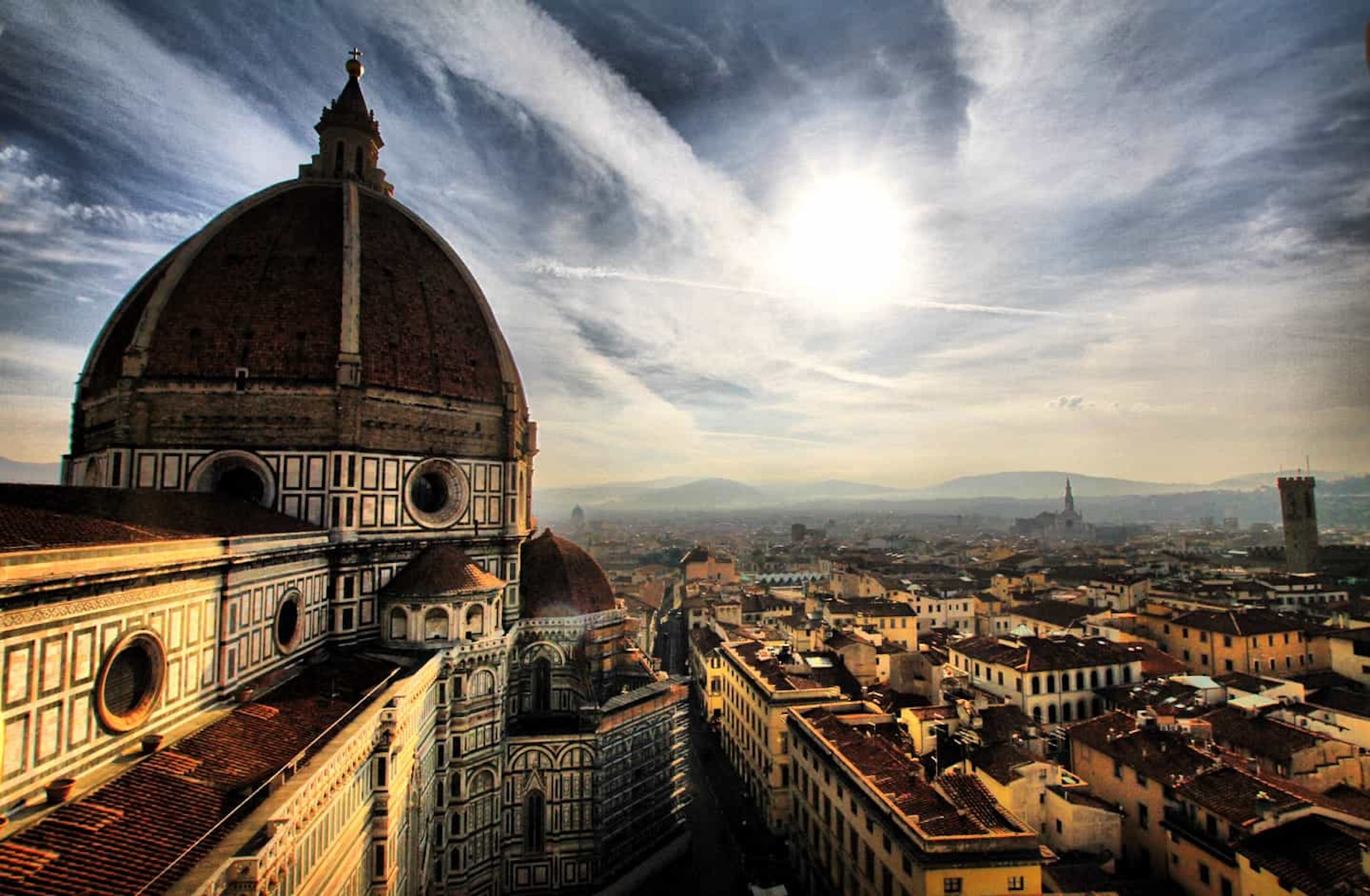
Despite its deep cultural history, Italy has only been a unified nation since 1861. Prior to that time and since the fall of Rome, Italy had been a collection of warring kingdoms, region-fighting-region for centuries. Shades of this rivalry are palpable even today as the people of Siena urge us to stay in their great city and forgo the time in Florence. Each region constantly trying to outwit, out play and out romance the other. Florence is one of Italy’s most historically significant cities and is home to almost half of the country’s total artistic heritage. Brunelleschi, Botticelli, Machiavelli, Leonardo da Vinci, Michelangelo, Raphael, all debuted in this great city, which is said to have more artistic treasures per square acre than any other city in the world.
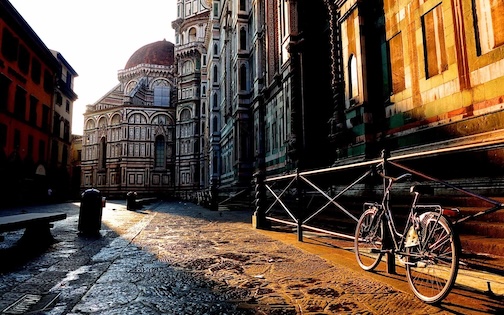
This is where Brunelleschi created the miracle of the Duomo, an engineering achievement so revolutionary that it stands today as one of the most courageous of all ages. Centuries later, his work would inspire and guide a mature Michelangelo as he designed St. Peter’s Basilica in Rome. This is home of The David, forever held in reverence at the Accademia Gallery. It is home of the Opera Per Santa Maria Novella, Michelangelo’s favorite church, which he affectionately referred to as “my wife.” It is a land of legends and myths and long remembered truths. In its national memory are the ruins of the Roman empire, underneath our feet as we stride across the Piazza del Repubblica. Emerging from every narrow street are statue-filled piazzas lined with cafes and trattorias.
Perhaps at no time is the Florentine passion for pageantry and procession more visible than to the surging crowds gathered around the Santa Maria del Fiore on Easter morning for the “scoppio del carro” (explosion of the cart) ceremony. As I woke to the sound of drums and cathedral bells tolling on the piazzas below, I was certain something big was taking place. I rushed down pushing my way through the crowd in confusion, and watched in amazement as a procession of hundreds of soldiers, musicians and people in 15th century dress paraded down the street. Transported in time, it seemed I might be the only one who didn’t understand what was taking place. Before long, I learned that this was the annual Easter ceremony, dating back to the first crusades and celebrated for centuries in the streets of Florence. As legend has it, “scoppio del carro” celebrates the first man to scale the walls of Jerusalem. As a reward for his act of bravery, his commander gave him three flints from the Church of the Holy Sepulchre, which were then carried back to Tuscany. It became the practice for a “holy fire” to be struck from these flints at Easter, which was then carried throughout the city by groups of young men bearing torches. As the sun climbed over the Duomo on this morning, with cathedral bells clanging, the crowd rose to a fevered pitch as a 30 foot cart, dating to the 14th century, rolled into the Piazza del Duomo by a team of white oxen, and with great ceremony exploded into a 20 minute fireworks display. A successful display from the “Explosion of the Cart” is supposed to guarantee a good harvest, stable civic life, and good business.
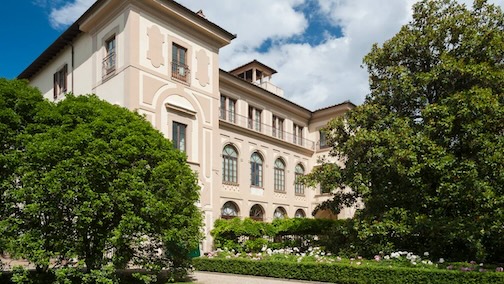
Just a 10 minute walk past the Duomo, beyond the dispersing crowds and into an almost other worldly realm, we stumble across an unexpected treasure. Down a side street and amid the usual buildings and facades stands a once fallen and forgotten palace home. Once home to a Pope, an order of nuns, Italy’s first railway company owner, five centuries of Florentine nobility and a Viceroy of Egypt (who sold it when his harem was barred from moving in) are two Renaissance palaces, which are today the Four Seasons Hotel.
Four Seasons via Four Seasons
The Four Seasons of Florence is a living museum of art history set within the walled tranquility of Florence’s largest private garden. The hotel’s colorful history unfolds through its ornately painted and crafted interiors, which have been returned to their original beauty following seven years of painstaking restoration.
Located on the edge of Florence’s historic center, the hotel occupies two protected buildings: the 15th century Palazzo della Gherardesca and the “Conventino” a 16th century Palazzo, which was once a convent. Between them lie over 11 acres of botanical gardens – the Giardino della Gherardesca – one of the most beautiful and undiscovered green spaces on the right bank of the River Arno.
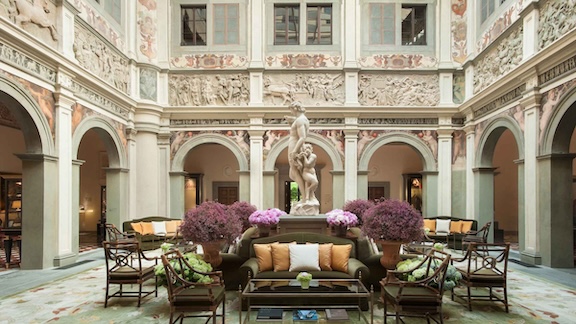
For generations, the very name Four Seasons has been synonymous with the highest standards of quality, service and elegance. Nowhere in the world could that be more evident than here in this place. As I walked the grounds and interior of the ancient palace turned hotel resort, a new masterpiece of history is interpreted into a modern day convenience. Behind its classical facade, the hotel is filled with 15th and 19th century artworks in their original context. Frescoes, bas-reliefs, stuccoes and silk wallpapers have been carefully restored to reveal vivid detail dating back over five centuries. Original works of art and architectural detailing can also be found in several of the hotel’s 116 bedrooms, suites and bathrooms. Throughout the property, the coats of arms of Scala and the Medici and Della Gheradesca families feature in paintings, stuccoes and stained glass and serve as further reminders of the building’s illustrious past.
Four Seasons Courtyard Lobby via Four Seasons
Entering the palace through the hotel’s imposing courtyard lobby, original 15th century stuccoes and intricate bas-reliefs stand in their original place, illustrative of the Renaissance tendency towards public displays of wealth. Flanking the courtyard are porticoes and barrel-vaults, decorated with an ornamental coffered ceilings, comprising thousands of painted, sunken panels.
For guests of this historic palace, views have new meaning as no longer does one need a room looking from the inside out. As I toured through the many rooms, specialty and royal suites, I was captivated by the preservation of Renaissance art on every wall, floor and ceiling of every single room. So mesmerized by the artistry inside, only occasionally did I pull myself to a window or terrace to look out over the vast green gardens. Amazingly, no two of the 116 rooms and suites are alike, each with individual dimensions, window sizes and idiosyncratic original frescoes, friezes, skylights and ceiling art. A total of 11 specialty suites offer distinctive historical art and features. La Villa, a secluded garden suite converted into a modern and sophisticated bedroom, living room, bathroom and separate sunken whirlpool, with floor to ceiling windows overlook a private terrace.
If that won’t do, try the Della Gherardesca Royal Suite, located on the ancient noble floor of the Palazzo, with a vaulted reception gallery, five large windows overlooking the hotel’s park, frescoed ceiling and original 18th century Capodimonte ceramic floor by Ignazio Chiaiese. Adjacent to the receiving room is a dining room with seating for 10, just in case you want a few close friends to join you for dinner.
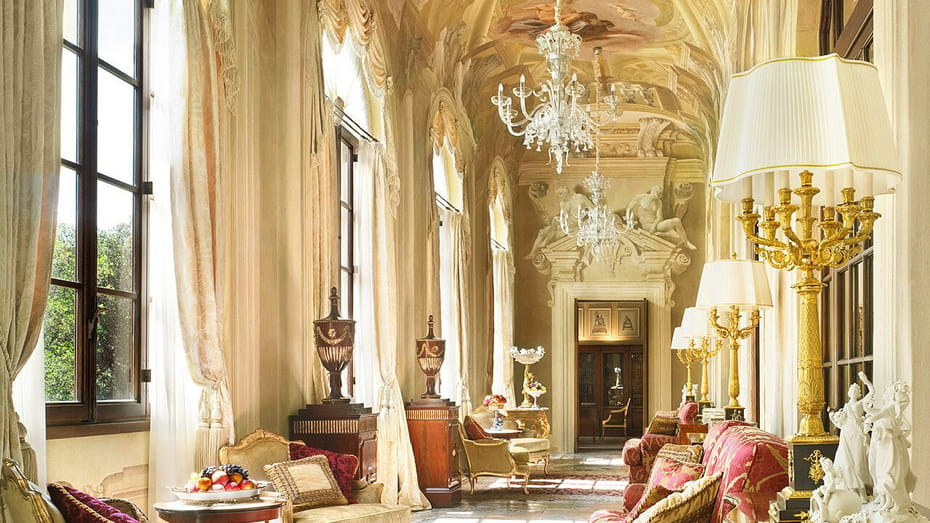
Royal Suite via Four Seasons
Most remarkable and enchanting on the property however, is the Coventino located at the far end of the gardens. A restored convent, this exquisite structure is practically a hotel within the hotel with 37 rooms and suites served by its own reception, concierge, breakfast room and business center. And inside is the actual church that once served residents of the convent. Restored to its 19th century design, its towering, vaulted ceiling and painted walls must create an impressive backdrop for banquets and galas.
The hotel also honors the city’s culinary and cultural heritage. Il Palagio, the main restaurant, uses Tuscan ingredients sourced direct from local producers. This is where we chose to close our evening, amidst remarkable Italian food in a setting preserved in time and among the graceful presence of servers who ease around us in a quiet, slow reverence. It is as though throughout the hotel, Four Seasons’ unpretentious and welcoming service is inspired by the warm hospitality of a Tuscan home. Amazing gentility juxtaposed to regal surroundings.
As I watched the candle light flicker against the elegant, other-worldly backdrop of this palace-turned-hotel, I sipped the last of my wine and thought of the journey ahead. The road from Rome had lead to the certainty of Florence’s charm and warmth and magical history. And tomorrow all roads would lead me back across Orvieto and into Rome once again. Leaving behind the richness and serenity of the past days struck chords of melancholy and something akin to pain. But I felt a sense of intense gratitude to have been allowed once again in my lifetime to sit alongside the Italian people, to hear their lore, to stare in awe at the baroque and renaissance masterpieces that they so leisurely assume among their daily landscape. The hospitality and reverence of this place seems a microcosm of the great Florentine spirit inside and outside the palace.
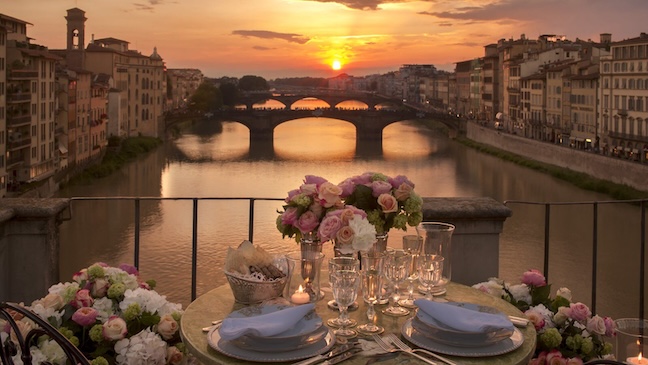
Florence Italy via Four Seasons
In the morning my driver will usher me back from whence I came. He will gesture in rhythm with his words. His profile will resemble the prominence of his ancestors. He will carry me across the vineyards and hilltops out of this enchanting land, back to the heart of Rome. But for now, I will sit with my wine, in the candlelight among the frescoes and friezes of this palatial hotel. As I took in the last of its spirit, my waiters circled to ensure my comfort, light danced across the painting above me as it had for hundreds of years, and somewhere in the recesses of my mind I was clear that what there is to know about a place pales against what there is to feel about it. And somewhere across the room, I heard a whisper of the words Florence...Firenze... Florencia.

All the World’s a Stage
Make sense of the week's news.
Charlatan reviews the worldview.
CHARLATAN
The Exposé of Politics & Style