Having extensively explored the labyrinth of intricate villages that make up the Big Smoke in the past ten years, I’ve strolled by elegant hotels more times than I can remember. Often pressing my nose to their immaculately cleansed windows I think fleetingly, “one-day.” Indeed, 2014 was the year to carry me over the threshold and to see how the other half live. My main concern was that I would be discovered as the impostor; that I had no place in such surroundings and I should head back to the burbs where the jobbing actors and artistes belong. I needn’t have worried. Not at the sumptuous Corinthia Hotel.
Occupying a strategic position just minutes from Trafalgar Square, Charing Cross, the theaters of the Strand and the River Thames, the Corinthia is as welcoming as it is grand. The building is steeped in history and demonstrates the most opulent of Victorian architecture; having been built in 1885 as the Hotel Metropole, hosting royalty and high-society. The government requisitioned it during the First World War and finally purchased it in 1936 when it became the administrative offices for the Ministry of Defence. The Corinthia group purchased it in 2008 and restored its fading beauty and grandeur to open its doors in 2011, providing 294 bespoke guest rooms and seven intimately designed penthouses. It is quite the antithesis of the generic hotel chain outpost.
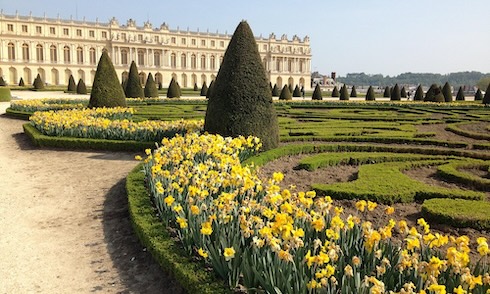
Palace of Versailles via Wikipedia
A Movable Feast
If the Palace of Versailles began as Louis XV’s modest hunting lodge in 1623, its vision didn’t come to fruition until 1660; when his son Louis XIV developed a passion for the site. Transforming the lodge into a country retreat, it was the young king’s intention to relocate the seat of government from Paris 25 kilometers into the countryside.
Louis XVI became king at 5 years old when his father, sensing imminent death, defied the custom of leaving the regency of France to his Queen, instead declaring a council that would rule on his son's behalf. The ensuring revolt, led by courtiers and aristocratic families on both sides of the aisle, marred most of his childhood and when he assumed the mantel of monarch at age 13 it was the greatest respect for internal conflict and revolution.
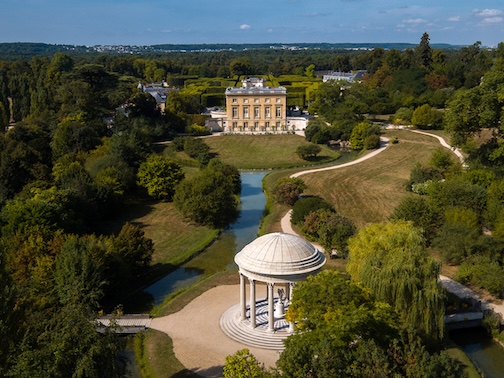
The palace grew exponentially over the next 50 years; first as a full-time residence for courtiers and aristocratic families, and subsequently as the official seat of the French government. Farms, gardens and villages came along in due course creating the infrastructure of a fortress and alternative to Paris. Even a Grand Trianon, a French style baroque chateau, was added in 1687 as a retreat for the king. The Petit Trianon, of course, was commissioned for his mistresses.
The Chateau of Versailles served as a principal royal residence and the official seat of government from 1682 until the French Revolution in 1789, and today is a historical monument and UNESCO World Heritage site. With upwards of 10 million visitors a year, the Palace of Versailles is the most visited historic site in the world.
Trianon Palace Versailles
By the end of World War II, the newly renovated Trianon Palace Versailles was again welcoming guests including internationally renowned figures in politics, major artist, writers and royalty. In 1990 major renovations were undertaken, and the new Pavilion de Trianon added a state-of-the-art conference center to its amenities. The Waldorf Astoria Hotel was given the management of the Trianon Palace in 2009 and presides over a historic venue of hospitality.
Trianon Palace accommodates 85 rooms and 15 suites, offering stunning views over the Park of Versailles or the hotel’s gardens. From innovative French cuisine at Gordon Ramsay au Trianon to contemporary continental dishes at La Veranda, Waldorf Astoria Versailles – Trianon Palace invites you to set out on an unforgettable gastronomic adventure.
Waldorf Astoria Trianon Palace Versailles is also home to the stunning Spa Guerlain, a 2,800m sanctuary of beauty, relaxation, and fitness. Designed to harmonize body and mind, this elegant spa offers the perfect reflection of the hotel's serene woodland surroundings. Majestic Roman pillars blend with an alluring modern design, crafting the perfect romance of ancient healing and contemporary luxury. It can fairly be said that Waldorf Astoria’s Trianon Palace is curating the experience of 18th century Versailles.
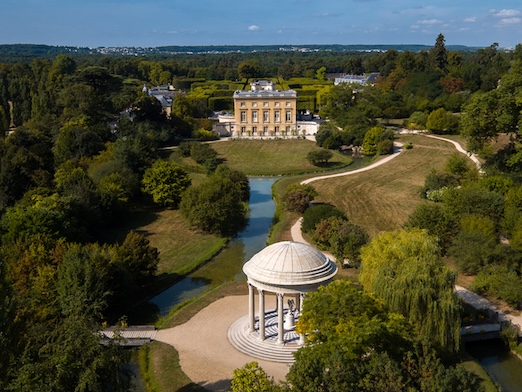
Trianon Palace via Waldorf Astoria
It was decadence, in fact, and extravagance for which the French Queen Marie Antionette was accused and ultimately died. On 5 October a large crowd mainly composed of women marched on and seized the palace. It was a day and time when the king was hunting and the queen was strolling in Trianon.
Though its widely held that the excess and extravagance of the French King Louis XVI, and his queen, Marie Antionette, led to the French Revolution, it was more practically a series of interlinking factors including economic recession, social disruption and a rampant plague called Tuberculosis that was leaving the nation destitute, impoverished and dead. The revolt bought the new and improved Republic of France a scant 100 years of relative peace until the Great War effectively engaged the entire world. World War I had over 40 million casualties, and 23 million wounded, making it the greatest anthropogenic disaster in human history. The ensuing Spanish Flu would infect 500 million people around the world, and while its death toll is debated between 17 - 100 million it is distinguished as the 2nd deadliest pandemic in human history.
The Palace of Versailles received 8,700,000 visitors in 2019 before the Coronavirus Pandemic marched through France touching 4 million people and leaving 100,000 dead. The pandemic ranks as the 7th most deadly in human history, having claimed 3 million around the world as of March 2021. Once again, Versailles is a veritable ghost town.
If the Treaty of Versailles was drafted in the Trianon Palace by the French Prime Minister, George Clemenceau, it was summarily signed by each and every member of the Allied Powers at the Palace of Versailles. It effectively ended the Great War and held Germany accountable for $442 Billion in reparations. Indeed, a heavy debt that was met by the rise of Nazi Germany.
We’ve learned through our sad experiences that economic hardships are conducive to radical nationalism, and the Treaty of Versailles thus became a recurring and popular theme of Nazi propaganda. Scorned as a “diktat” imposed by an “international clique,” Adolf Hitler referred to the treaty as “The bride of Versailles.”
Originally built as a country house, it was decided by Louis XIV that Versailles would become a showcase. A gulf into which the labor of France poured its earnings for nearly 100 years. That the nation evolved from a kingdom to the Republic of France presupposes that the collective consciousness was evolving, too. Little by little the old-world crumbles and while the emperor, king, chancellor and queen never imagined those pieces would fall around them, a young prince — the mastermind of Versailles — was wise enough to pity and care.

All the World’s a Stage
Make sense of the week's news.
Charlatan reviews the worldview.
CHARLATAN
The Exposé of Politics & Style