The Slaughter House
As America turns 250, the republic has assembled a colorful cast of characters. Charlatan follows what could be the biggest turnout in a U.S. midterm election cycle to a whodunit, American-style reckoning.
By Drew Gowing1 November 2026
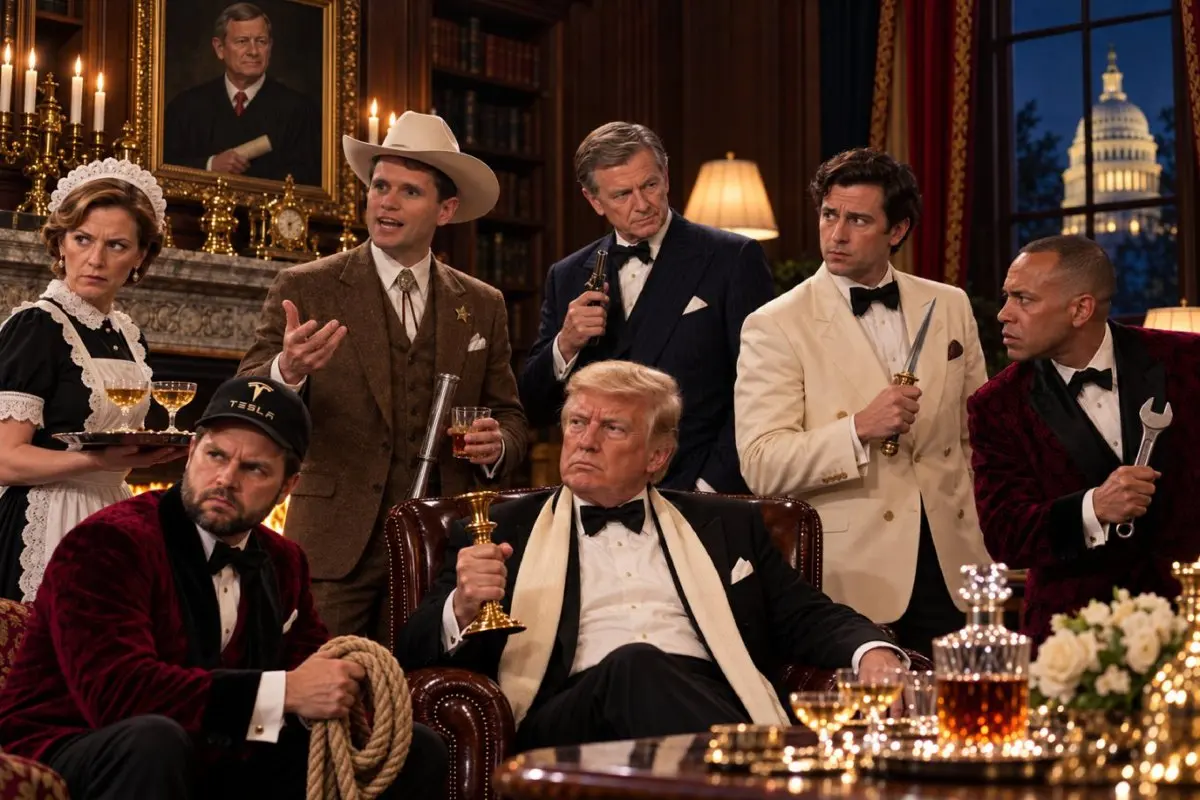
A train pulls into the station two days before Election Day and the platform is already roped off. The passengers file out slowly: a president, a billionaire, two advisers, nine justices, a handful of independents, an army of consultants, and thousands of candidates — the most in any midterm election cycle — each insisting they were asleep in their compartments when it happened. In the last car lies the victim: the American republic found dead in the year of its semi-quincentennial.
Every passenger had a key. Every passenger a motive.
The passenger manifest leads to one address: The Slaughter House, where the suspects will soon gather and the evidence will be laid out for inspection.
Part I: The Crime Scene
At 250, the state of the union represents an economic and constitutional crisis that cannot be attributed to a single president, political party, or election. The national debt exceeds $40 trillion. Freddie Mac’s 30-year rate is 7.24% (Oct. 29) and yes, of course—gas. It’s expensive at $4.23 per gallon, up 39% from a year ago in step with the president’s undeclared war with Iran. The official year-over-year inflation rate is clocked at 3.7% as of this writing.
Moreover, America’s tech billionaires are unilaterally taking foreign policy negotiations and military operations into their own hands; AI companies have been remanded to the honor system; and U.S. Immigration and Customs Enforcement (ICE) has doubled in size to 22,000 officers and agents.
Legal scholars, civil rights groups, and congressional watchdogs are accusing the sitting president of running afoul of the U.S. Constitution and established separation-of-powers doctrine through executive overreach, challenges to institutional checks, and expanded presidential authority.
Impounding congressionally appropriated funds, undermining independent regulatory agencies, and using an expansive Unitary Executive Theory to bypass statutory limits and remove career civil servants, the president’s policies have drawn intense scrutiny for potentially violating due process and civil liberties through mass deportation plans, attempts to end birthright citizenship, the deployment of federal forces in domestic cities, and the relentless retaliation against public dissent. These actions, combined with allegations that his global business holdings violate the Foreign and Domestic Emoluments Clauses, and his frequent defiance of lower court injunctions, have created an unprecedented strain on institutional norms and the limits of presidential immunity. The president’s approval rating lies in the very low 30s, there interred with the lowest approval ratings in presidential history.
There is an unofficial fourth branch of government called the Independent Federal Agencies — historically designed and legally structured to act as non-partisan watchdogs. Independent regulatory commissions like the Federal Trade Commission (FTC), Consumer Product Safety Commission (CPSC), and National Labor Relations Board (NLRB) were built with bipartisan boards and staggered terms so they could police the economy, corporations, consumer markets, and public interest without bending to political pressure from any one administration.
For nearly a century, Humphrey’s Executor v United States (1935) held that presidents could not remove the commissioners from independent agencies for disagreeing with the White House. A president could only remove the commissioners for cause (inefficiency, neglect of duty, malfeasance) which ever since FDR has kept commissioners insulated as independent watchdogs rather than direct extensions of presidential will. In June, the Supreme Court reversed those protections enabling presidents to reshuffle the independent agencies—At Will. Former FTC Commissioner Rebecca Slaughter reacts to Trump v Slaughter:
Today’s ruling makes it possible for presidents to fire watchdogs who won’t put politics over principle and replace them with lap dogs. It’s a recipe for corruption; working families will pay the price.
In her dissent, Justice Sotomayor invokes the American Revolution. “A power unknown even to the English Crown against which the Founders revolted, elevating him above his once-coequal branches.”
Americans see themselves in paychecks that buy less, healthcare that costs more, and confidence in government that continues to erode. The security of families, the integrity of borders, and the future of a country increasingly difficult to recognize weigh heavily on the electorate. On 3 November 2026, as many as 125 million Americans could return to the polls to react to the nation’s “affordability crisis,” and recalibrate the political future of a nation celebrating its 250th anniversary.
Part II: The Manifest
The approaching midterm elections offer something more revealing than another referendum on presidential power. The possibility of a change in congressional control has revived Democratic ambitions while the Republican Party confronts the uncertain future of a political movement larger than any conventional party platform. The electoral arithmetic will determine who governs Congress. It will do little to explain the country that elected them.
For now, the names on the manifest matter less than each passenger’s constitutional berth. At the Slaughter House, their levers of power will be laid bare like weapons to prove means, opportunity, and motive.
The Unusual Suspects
The Unitary Executive. He believes Article II of the Constitution vests complete control over the entire executive branch and its administrative officers directly in the president. In this way, he keeps faith with like-minded predecessors from President Harry Truman to the present day.
The Accomplices. Every president needs a spymaster. Stephen Miller, “The Architect,” and White House deputy chief of staff, loads scores of executive orders onto the president’s desk, now more than 500 across two terms. Russell Vought, “The Reaper,” a budget director and chief architect of Project 2025 supplies the doctrine: a president who may refuse to spend what Congress appropriates, and a unitary executive answerable only to himself. One loads the weapon. The other cocks it. Neither was invited to the party by the People.
The High Court. In the space of two months, nine justices are responsible for interpreting the law, rewriting the rules, and recalibrating the ethics of the republic. On April 29, Louisiana v Callais requires voters challenging discriminatory maps to prove intentional discrimination, what Justice Elena Kagan calls the “now-completed demolition of the Voting Rights Act.” On June 29, Trump v Slaughter ends nearly a century of independent oversight. Both decisions were 6–3. Not one of the nine justices was ever invited to the party by the People.
The Billionaires. Elon Musk throttles service to Ukraine on October 14, 2026. “Ukraine military violated Starlink terms of service and used it for offensive drone strikes to kill people,” Musk claims. He disrupts front-line military logistics and drone operations before restoring speeds on October 24. “The bottom line,” the president says, “he put it back.”
In other news, a whistleblower in 2025 alleges that Musk’s Department of Government Efficiency (DOGE) siphoned gigabytes of sensitive case files from the federal labor board investigating his companies. The agency denies it. Still, DOGE was dismantled and thus ejected from the party.
The Maps. At the president’s urging, Texas redraws its congressional map mid-decade to create up to five more winnable Republican seats. On the north side of Austin, a driver can now pass through five congressional districts in about ten minutes. Florida, North Carolina, Ohio, Tennessee, Alabama and Louisiana follow. California retaliates with five Democratic seats of its own, suspending the very citizens’ commission it once held up as the nation’s model for fair maps. In a republic built on voters choosing their representatives, both parties are now rounding up their own constituents, congressional districts, and preferred guest lists to the proverbial party.
The Machinery. It is the most expensive election cycle in American history: $11.6 billion in political advertising (AdImpact). More than $137 million goes to ads built with artificial intelligence, and California’s Governor Gavin Newsom is the most notable Democratic user of AI deepfake videos trolling the president. Nearly half of all AI videos depict real politicians in fictional scenes and scenarios. Most carry no disclosure. No federal law prohibits it. State actors and tech platforms are operating in tandem with impunity, creating information chaos, and crashing the party.
Part III: The Drawing Room
The voters convene in the Drawing Room: the school gymnasiums, church basements and fire stations of the republic. Some 50 million Americans have already slipped their ballots through the door before Election Day. This year, the party requires extra security.
The Justice Department (DOJ) sends roughly 1,000 federal monitors to the polls, drawn if you please from the Bureau of Prisons. The DOJ sues 30 states and the District of Columbia for their voter rolls losing nearly every case, and late Friday a federal judge ordered the DOJ to stop threatening the officials who count the votes.
In Alaska, the DOJ has opened a criminal investigation into a time-honored tradition in American politics called ballot stacking. Asked about the Alaska lawsuit, the president offers a confession: “I’m the one that said, ‘Do it.’”
The slaughter itself could take place in any combination of nearly a dozen rooms. Republicans’ path to keeping control has nearly evaporated, whilst the encroaching Democrats need to pick up three seats in the House and four in the Senate to take both chambers. Every suspect holds a key but can only speculate as to what doors in principle they unlock.
Imagine the suspects gathered beneath a portrait of Chief Justice John Roberts, with the Capitol gleaming like a shining city on a hill. The candlestick, dagger, lead pipe, revolver, rope and wrench are all accounted for. The murder weapon, as yet, remains remarkably elusive.
The Voters
The train prepares to leave the station, but the voters are left behind. He and she carry no badge, no warrant, no proxy vote, Super PAC or electronic voting system. Only a pen or stylus and a ballot. They still trust the count: 79% of registered voters are confident that ballots cast in person will be counted as intended. It is nearly everything else they question: the economy, Iran, healthcare, immigration, the president’s power, artificial intelligence, data centers, and democracy. Asked what troubles them most on the eve of the vote, they no longer name groceries or gasoline. They name corruption.
Rep. Greg Casar of Texas, chair of the Congressional Progressive Caucus and a member of the Oversight Committee, wants Congress to investigate “the corporations and ultra-wealthy individuals who have sought to corrupt our government.” He adds: “Elon Musk is on that list.” Musk replies via post: “Live by the sword, die by the sword. Those who pick fights with me should understand that I will find out who is really pulling the strings and come for them, not just their puppets.”
Republicans fear a Democratic Congress will bring socialism, open borders and higher taxes. Democrats fear a Republican Congress would hand the president unchecked power, more deportations and a longer war. Each side imagines nearly twice as many extremists across the aisle as actually exist, and Musk warns on Friday that a Democratic sweep would make America “a permanent one-party state” and ultimately mean “the end of democracy in any meaningful sense of the word.” Perhaps why Musk’s midterm retainer now exceeds $442 million.
Part IV: The Independent Inspector
An independent inspector has been following a lead, through it comes woefully too late. While passengers argue on the platform over who struck the blow, the train begins lurching forward and begins pulling out of the station. Nine figures in black robes watch through the windows of the dining car like glass coach.
For it is they who penned the smoking gun into law. On April 29, Louisiana v Callais instructs voters to prove intent before the courts will protect their districts. On June 29, Trump v Slaughter follows up by handing the sitting president the keys to every watchdog in Washington. Both rulings were 6–3, and both are now the law of the land. No ballot on Tuesday carries their names. No placards, no elections, no politics are claimed. They hold a first-class compartment with a lifetime pass with one constitutional caveat. They can only preside via Article III: "The Judges, both of the supreme and inferior Courts, shall hold their Offices during good Behaviour."
The portrait above the Drawing Room mantel offers a final clue. The Inspector notices that the painting over the fireplace does not bear its subject’s name, but rather the name of a bill before Congress and a telephone number to which 65% of Americans — two-thirds of Republicans and most Democrats — are aligned.
The ROBE Act. U.S. Capitol Switchboard (202) 224-3121
The guardian’s whistle splits the air. Doors slam down the length of the train, one after another, like a verdict read aloud. The engine heaves its first great breath, wheels slipping on the iron, and the couplings snap taut, car by car.
A deafening political noise rolls across the crowd, swallowing the spirit of the nation. A digital glow from within the dining car illuminates the brethren in sable robes, ever doomscrolling past life and living toward an originalist interpretation of the Constitution. A green flag waves the “all clear” as the final cars pass into the darkness and death of an experiment in democracy, rendering the nation’s reflection in the smoke and mirrors of the spectacle.
The Slaughter House Express has left the U.S. Capitol with a manifest of suspects who can ink up the laws, legislation, and very soul of the nation unchecked. Leaving the voters on the platform with only their pen or stylus and murder weapon to serve, save, and rightfully rule their republic.