CHARLATAN
The Exposé of Politics & Style
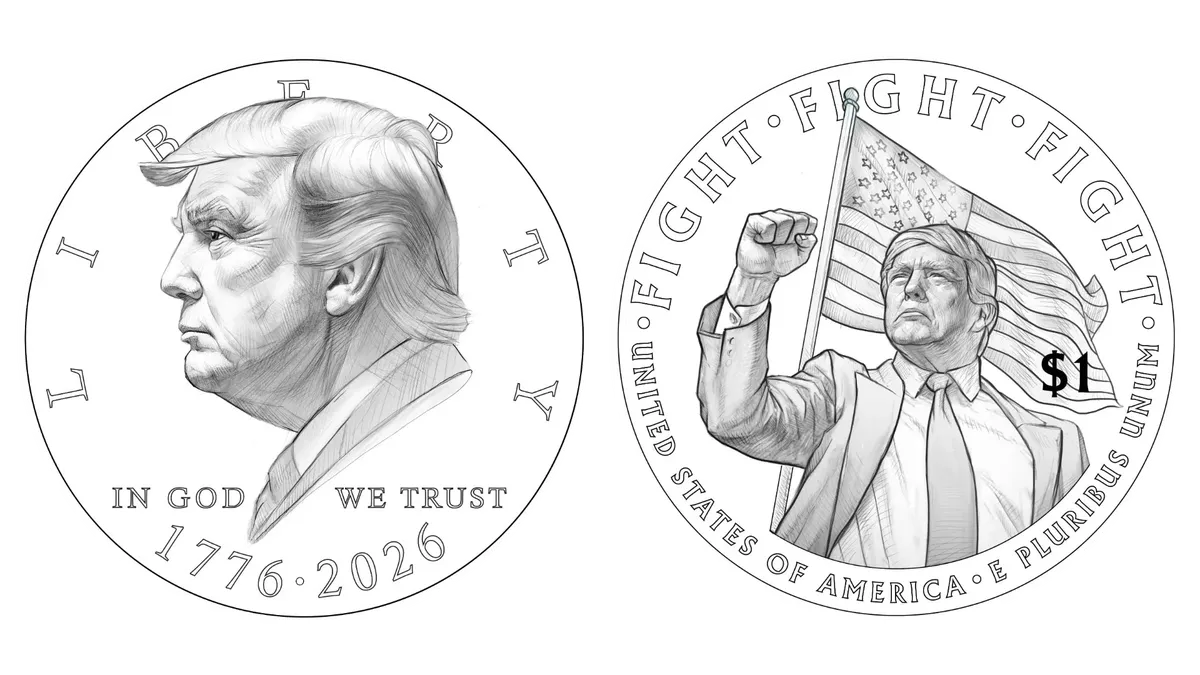
President Trump wants his likeness featured on a new $1 coin and a 24-karat commemorative gold coin issued by the U.S. Mint for America's 250th anniversary. The gold coin design depicts him leaning on the Resolute desk, while the $1 coin features a raised fist on the back with the words "FIGHT FIGHT FIGHT."
When Spencer Clark, a Treasury bureaucrat, was told to put explorer William Clark on a five-cent note, he simply substituted his own portrait instead. An Act of Congress reacted by passing the Thayer Amendment in 1866. "Hereafter no portrait or likeness of any living person shall be engraved or placed upon any of the bonds, securities, notes, or postal currency of the United States." It said nothing of coins.
A separate 24-karat gold commemorative, also approved for the anniversary, puts Trump's likeness on the front and a bald eagle on the back. Treasury Secretary Scott Bessent explains: "There is no profile more emblematic for the front of this coin than that of our serving President."
To wit, there is also a special edition passport with Trump's face presiding before the Declaration of Independence; a proposed $250 bill that required its own act of Congress; a national parks pass that shuns the eagle's image for his own; a cascade of banners on federal buildings; and tents if you please popping up on fairgrounds across the nation selling Trump Accounts. By rights, a brazen monetization of brand.
When we drive past Walmart for Target across town, we seldom if ever really know why. We'll say it's cleaner, better organized, more cost effective. Arguably true—but perhaps not the complete truth.
Target costs about the same, stocks the same manufacturers, but looks like someplace we'd rather be seen. Still, that same brand reputation turned into a liability overnight in 2023, when a Pride Month clothing line drew boycotts from one direction, accusations of cowardice from the other, in reaction to a company that reversed course and pulled its own DEI initiative off the shelves. Amazon founder Jeff Bezos puts it this way: "Your brand is what others say about you when you're not in the room."
We pay more for the same detergent because of the picture on the box. We drive to a better part of town with worse prices with a lick and a promise on credit. Still, no single person has ever been permitted to become America's prestige brand. The eagle, the seal, the anonymous engraved president — all of which were designed, deliberately, so that the state would outlast the servants running it. If a president appears on a coin during his own presidency, does he break a law, break with tradition, or rightly interpret both? The $1 coin is either the next chapter or the first counterfeit.
The $1 coin is either the next chapter or the first counterfeit.
There isn't a single, universally accepted American identity but rather competing ones — and the tension between them has always been encoded in the American Way.
The Great Seal wasn't handed down whole. Congress appointed a committee the day after the Declaration was signed in 1776, and it was finally finished in 1782 by Charles Thomson, the Continental Congress's secretary. The eagle, an unfinished pyramid, and the motto E Pluribus Unum were assembled piecemeal by three committees over six years, not authored by a single visionary.
A creedal nation gathers America around an ethos — life, liberty, the pursuit of happiness — whilst a cultural-historical nation gathers around a specific tranche of immigrants assimilating into the American experiment. Political scientist Samuel Huntington alights in Who Are We? The Challenges to America's National Identity: "We have to know who we are before we can know what our interests are."
The flag added stars without redesigning its meaning. The seal was deliberately kept off circulating currency for decades. Presidents' faces went on coins only after death, and only slowly — Lincoln wasn't on a coin until 44 years after he died. Every evolution trended toward more abstraction and more delay before any individual got attached to the symbol — the opposite direction from what's happening now.
That's because there was never a single "official" American brand to violate, but rather a working consensus that deliberately avoided ever crowning a single face or icon as its mascot. As the U.S. Constitution is 'a living document,' America as brand is a meticulous, multi-colored tapestry designed as a dynamic work in progress. The U.S. Constitution's Preamble begins:
We the People of the United States, in Order to form a more perfect Union...
"To form a more perfect Union" is comparative, not a superlative. It's not a perfect union but rather "a more perfect union" than what came before, with the clear implication that more work remains after. The Framers did not treat this as a rhetorical flourish. Article V of the document they wrote is an amendment procedure — instructions, built into the founding text itself, for how future generations can and should amend it.
The phrase was first critiqued when the American brand itself was being challenged. After the Civil War, the same three words were invoked to justify a federal government finally strong enough to act on its own citizens—not just negotiate with the states that claimed them. In 2008, Barack Obama reached for the same phrase to answer a controversy over his own pastor's words about race — using the Constitution's oldest promise to argue that the country's flaws were something to keep working on, not something to flee from. Lincoln used it to bind the states together by force. Obama used it to ask whether the binding had ever been finished. Neither treated "a more perfect Union" as a claim but rather as an unfinished masterpiece.
The American brand is something no single person, party or president can claim. It's not a seal or emblem or even a face on a coin as much as an admitted incompleteness — a country that wrote its own unfinished-ness into its founding contract, purposefully. For the alternative suggests the job is done, the argument won, and binds the nation's promise, posterity, and possibilities to it.
America was not designed as a single image printed on a passport, coin, or pass. It is the argument for why no single image ever should be, remade — not just remembered — by every generation that inherits the republic. That tension is America at its finest until it breaks.

All the World’s a Stage
Make sense of the week's news.
Charlatan reviews the worldview.
CHARLATAN
The Exposé of Politics & Style