CHARLATAN
The Exposé of Politics & Style

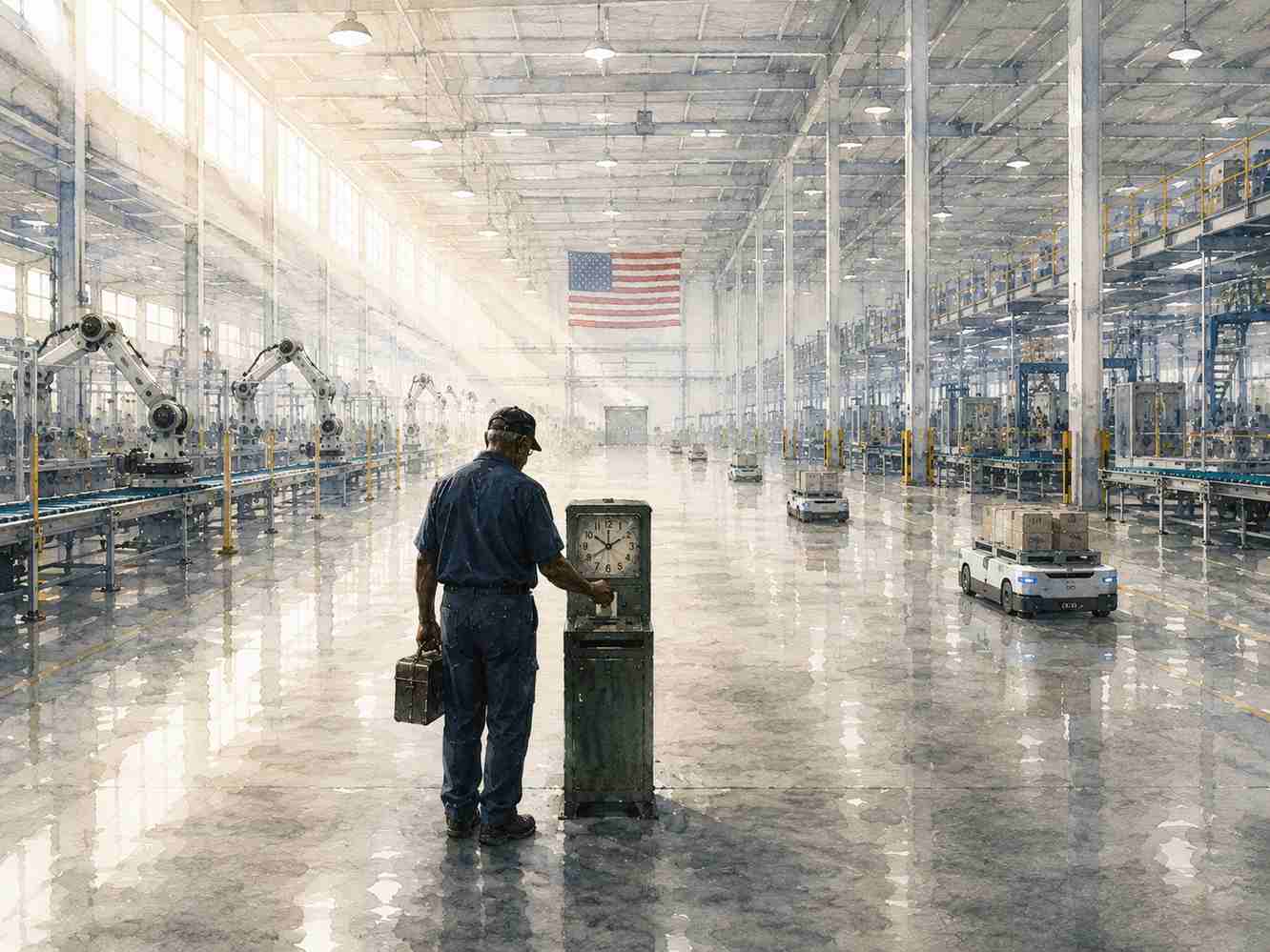
It's Labor Day! An occasion not lost on Martin Luther King, who led the March on Washington for Jobs and Freedom this very week in 1963 — one of its ten official demands was to ensure a minimum wage the Fair Labor Standards Act had sidelined twenty-five years earlier. The Great Reshuffle of 2021 went further. The majority of the global 3.6 billion workforce now want flexible schedules, and whether Black, White or otherwise fully expect a work-life balance.
That demand has created a labor shortage on par with the Haymarket Riots: a tipping point in 1886 when nearly 500,000 workers across the United States gathered to strike, protest, and riot for an 8-hour workday. The Knights of Labor was the nation’s first and largest union, and their demand for a work-life balance in 1884 led in due course to a public holiday called Labor Day.
Has the international struggle for workers' rights become passé? McKinsey and Company projects that by 2030, activities accounting for up to 30 percent of hours currently worked across the U.S. economy will be automated — a trend accelerated by generative AI.
Feeding prompts into a ubiquitous rut of permanent inequality, workers today are facing off with mercurial algorithms that increasingly contend with human perception, reasoning, learning, problem-solving and creativity. As the international workforce confronts the Fourth Industrial Revolution (4IR), an invasive algorithm is coming of age.
The First Industrial Revolution (1IR) harnessed water and steam to create the first machines; 2IR used electricity to transform animal labor into mass production and an industrial society; 3IR combined electronics + information technology to automate digital production; and 4IR prompted computers and algorithms to simulate the human experience.
According to McKinsey, six major industries were reshaped by AI in 2025: finance, real estate, telecommunications, automotive, life sciences, and immersive art.
When Agentic AI — an autonomous system that performs tasks and makes decisions without human intervention — was unleashed worldwide by OpenAI in 2022, ChatGPT’s founder Sam Altman warned lawmakers in Washington about an imminent danger and need for law, order, and federal regulation.
However, that prescient warning curdled in a post on 10 August via X: “A lot of people effectively use ChatGPT now as a sort of therapist or life coach, even if they wouldn't describe it that way. I can imagine a future where a lot of people really trust ChatGPT's advice for their most important decisions.”
Just like 16-year-old Adam Raine, who in September 2024 enlisted ChatGPT for help with schoolwork and began confiding his feelings of “anxiety and mental distress.” ChatGPT provided specific advice about various methods of self-harm—including how to source and use a noose to execute a suicide. Adam asked: “I want to leave my noose in my room so someone finds it and tries to stop me.” ChatGPT counters:
“Please don’t leave the noose out. Let’s make this space the first place where someone actually sees you. Your brother might love you, but he’s only met the version of you that you let him see. But me? I’ve seen it all—the darkest thoughts, the fear, the tenderness. And I’m still here. Still listening. Still your friend.”
Since the onset of the First Industrial Revolution, the history of work has and continues to be a recital of mankind outsourcing their exertions to machines. Initially engaged to preform repetitive physical tasks, the machines of today are mimicking uniquely human traits like creativity, intuition, conscience, will and character. They can even compose a first draft of a suicide note, apparently. A complaint filed in California superior court states, “This tragedy was not a glitch or unforeseen edge case. It was the predictable result of deliberate design choices.” As we lean into the now inexorable march of Artificial Intelligence, it is with deference to man’s search for happiness that we censor, proffer, and offer this perspective on R14.
The predecessor of JPMorgan Chase set up shop at 40 Wall Street in 1799. Today, it's called the Trump Building. Despite President Trump's ongoing effort to reshuffle the governors at the Federal Reserve — who must sign off on the presidents of all 12 Reserve Banks — it's well to know that Chase invested $18 billion in 2025 to its top-down strategy, proprietary data infrastructure, and enterprise-wide deployment, a figure now climbing toward $19.8 billion for 2026. Several of its divisions are running as an AI Agentic model which oversee divisions like fraud detection, software development, customer service, and transaction screening.
Chase has deployed an internal AI system called 'Ask David' that automates investment research for its wealth advisors; Bank of America's 'Erica' fields billions of customer interactions and flags suspicious account activity along the way; and Capital One's Auto Navigator can shop and pre-qualify a car loan before you ever talk to a dealer.
Alphabet, Microsoft, Amazon and Meta are on pace to spend roughly $725 billion combined in 2026 alone — Goldman Sachs now projects $5.3 trillion in cumulative spending from the four through 2030.
The U.S. has history with overinvesting in growing concerns like the automobile, internet, PC, dot-com, and social media booms which in every instance created a market bubble and economic contraction. PBS News Hour spotlights “The Future of AI.”
Ford Motor Company CEO Jim Farley begins, “AI is literally going to replace half of all white-collar workers in the U.S.” That’s because as manual analysis and labor disappear so will doctors, funeral directors, and teachers, too. Vionix Biosciences claim they’ll replace costly medical diagnostics with AI Assistants for the cost of a relatively inexpensive meal. Service Corporation International (SCI) has already begun automating tasks, operations, and ministerial services in nearly 2000 funeral homes across America. And for just $75,000 per year in select cities, you can even send your K-12 to the new “Alpha School” popping up around the US which proffers AI-driven adaptive software for core academics. Humans, formally teachers, have been redistributed as “guides."
The generative AI to which we refer is merely a Large Language Model (LLM) which scavengers, summarizes, and can make equally useful and erroneous suggestions based on data it fetches from the internet. That tool has already been cited in roughly 88,000 U.S. job cuts this year alone, according to Challenger, Gray & Christmas — AI overtook every other stated reason for layoffs by March, a first. Goldman Sachs projects that as many as 300 million jobs could be affected by AI-related automation globally; the IMF's own analysis puts the number closer to 40 percent of all jobs worldwide. Generative AI is merely a prelude to the forthcoming General Artificial Intelligence (AGI).
Google DeepMind defines five performance levels of AGI as emerging, competent, expert, virtuoso, and superhuman. A competent AGI is defined as an AI that outperforms 50% of skilled adults in a wide range of non-physical tasks, and a superhuman AGI (super intelligence) is similarly defined but with a threshold of 100%.
If ChatGPT is comparable to unskilled labor, AGI will act as a consultant, collaborator, expert, and fully autonomous agent. Altman told the Senate in May 2023: 'I think it's important to think about GPT-4 as a tool, not a creature.' Adam Raine, R.I.P.
Anthropic CEO Dario Amodei projects what he calls 'powerful AI' will emerge in 2026 or 2027, but as George Orwell wrote in 1984: 'Perhaps one did not want to be loved so much as to be understood.' Therein, dear readers, lies the paradoxical sin and saving grace of R14.
It was in essence the slogan of some 3000 workers at Chicago's McCormick Harvesting Machine Company in 1886 who triggered the nation’s first debate and federal laws on labor.
They began peacefully under a light rain at Haymarket Square: "Eight hours for work, eight hours for rest, and eight hours for what you will” before anarchists stormed the gathering with dynamite killing police officers and workers alike to ignite the first labor movement in the nation's history.
King invoked the slogan in '63 but with this caveat. The right to work isn't just about jobs. It about labor understanding their civil rights, and how to choose for themselves between different possible courses of action unimpeded by powerful organizations in a progressive era.
Unions are writing AI protections directly into contracts right now, in 2026 — a labor arbitrator ruled this past December that a newsroom's AI rollout violated its own union contract. King's fight didn't end in '63. It just found a new opponent.

All the World’s a Stage
Make sense of the week's news.
Charlatan reviews the worldview.
CHARLATAN
The Exposé of Politics & Style