



The Affordability Tour
As the Feds cut interest rates whilst inflation rises, Charlatan follows AI to private credit lenders, a financial crisis, and man’s ubiquitous search for “Universal Extreme Wealth.”
Benjamin Netanyahu apologizes to Qatari Prime Minister at White House 29 September 2025.
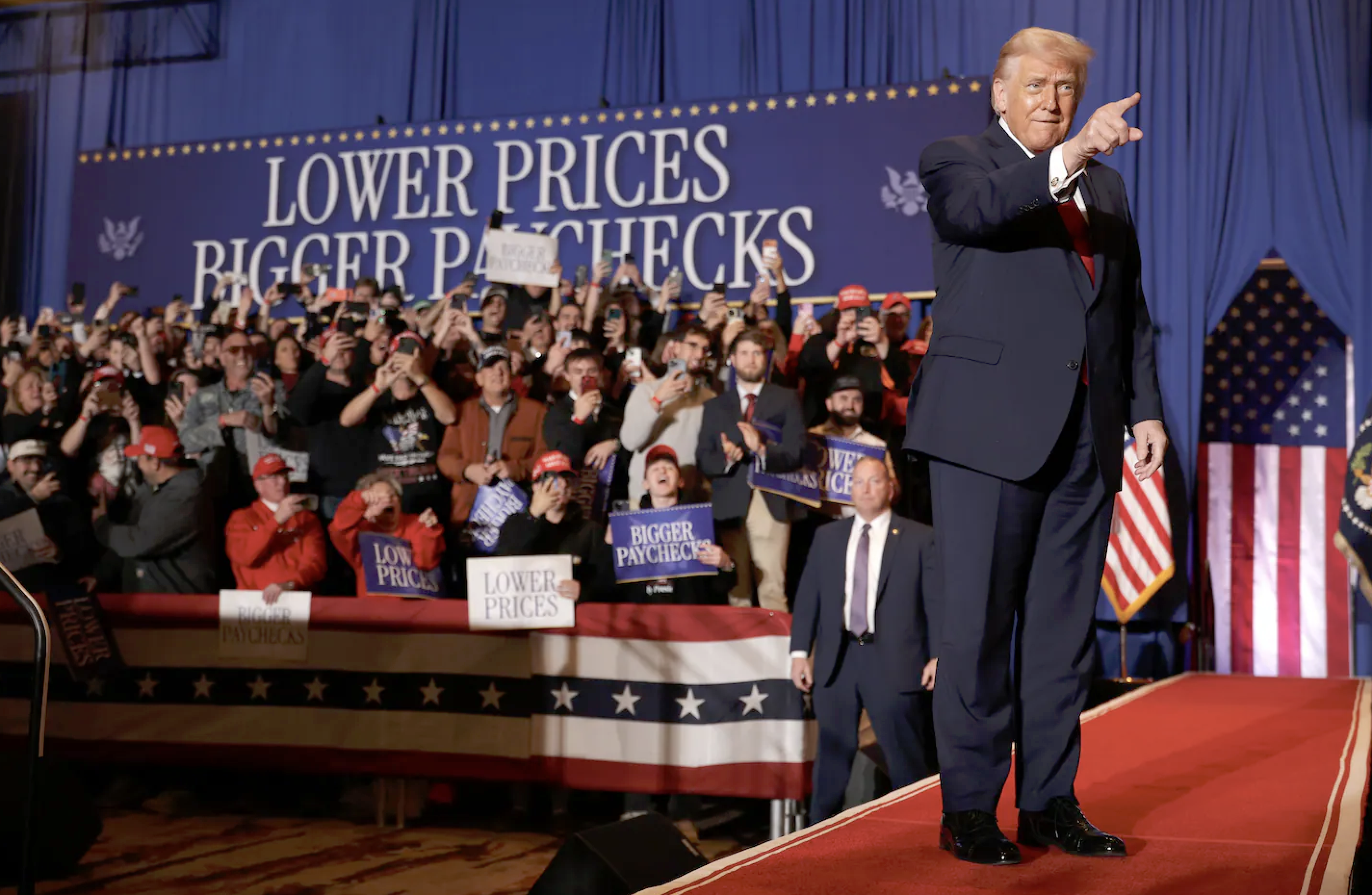
As the Fed cut interest rates by a quarter point, President Trump's multi-state speaking tour got under way to promote his economic policies and address voter concerns about high prices with a tagline: "LOWER PRICES — BIGGER PAYCHECKS." Still, only 31% of U.S. adults approve of how Trump is handling the economy, according to a poll from AP-NORC.
The Affordability Tour was billed as “an opportunity to connect with Americans struggling with rising costs,” but is materializing as a campaign-style rally where Trump simultaneously calls affordability his highest priority whilst mocking the term itself as a Democratic "hoax.” He suggests Americans can and should simply do without. "You don't need 37 dolls for your daughter... Two or three is nice." Trump did in all fairness make his own daughter fly coach on a transatlantic flight once, an experience she described as "spectacularly unfair.”
And because an inflation update isn’t scheduled for release until 18 December 2025, fresh facts as yet can’t foil either the message or messenger. The Federal Reserve cutting interest rates by 25 basis points on Wednesday — between 3.5% to 3.75% for a third consecutive rate cut this year — coincides with inflation hovering at around 3 percent, and Trump’s roadshow about bringing prices down while the most recent data shows inflation ticking upward. “Contradictions do not exist,” Ayn Rand said. “Whenever you think that you are facing a contradiction, check your premises. You will find that one of them is wrong.”
In 2025, investment in artificial intelligence reached historic highs, with total global spending projected to hit approximately $1.5 trillion. While the breakneck growth rate seen in 2024–2025 may ease, total spending is expected to continue as the focus shifts from pure infrastructure building to widespread enterprise adoption and orchestration. Gartner predicts total AI spending could reach $2 trillion in 2026. To say nothing of the funny money.
Private credit is any lending by non-banks. Think pension funds, insurance companies, and sovereign wealth funds that sidestep banking regulations. It’s a 3 trillion market today, according to Morgan Stanley Research, but when a company or group companies create invoices — and can sell those invoices or debt to third-party investors — they create a harbinger of risks akin to the 2008 financial crisis. McKinsey estimates the private credit market will reach $7 trillion by 2030, and the United States dominates ¾ of that market worldwide.
Consider this. Though it remains firmly in the realm of political theater, Trump promising to send a $2000 "tariff dividend" check by mid-2026 to ALL Americans; funded by nearly $195 billion in customs duties in fiscal year 2025; and timed to arrive just ahead of the midterm elections could present a murky problem with a specific relief.
Tariff dividends proffer a murky problem with a specific relief.
Can tariffs — which levied a higher tax on American consumers through higher prices on imported goods — assuage those same Americans via a $2000 "tariff dividend?” Recall Covid stimulus money producing too many dollars chasing too few goods? Economist Thomas Sowell observes, “Inflation is the most universal tax of all.”
At the cortex of contemporary political economy lies an unprecedented transformation—one that threatens to reshape the very foundations upon which Western capitalism has stood for centuries. As artificial intelligence systems ascend to capabilities once reserved for human cognition, the tech elite have begun whispering what was once unthinkable: a Universal Basic Income (UBI) may not be a progressive fantasy but an economic necessity.
OpenAI’s Sam Altman has evolved. His original thinking was that a UBI would be the saving grace to the AI revolution. Today, he refers to a redeemer called "Universal Extreme Wealth” (UEW): An ownership stake in AI's bounty for every citizen. This is not the prognostication of an academic or economist cloistered in an ivory tower, but rather the clarion call of a kingmaker or central engineer of the Intelligence Age.
Recent economic modeling from Cornell suggests AI systems need only achieve five to seven times the current automation productivity to finance the 11%-of-GDP necessary for a UBI, even assuming zero new job creation. A threshold, once considered science fiction, accelerated by a thrush of AI technologies but exacerbated by the private credit industry.
The math is sobering. Industry experts project AI could replace as many as 50% of jobs in certain sectors by 2027, according to Taxproject. A timeline that makes the Industrial Revolution's displacement appear leisurely by comparison, and evidence from pilot programs offers a glimpse of UBI's potential. Altman's own three-year study provided a $1000 monthly annuity to low-income recipients and proved beyond a shadow of a doubt and in the realm of his own virtual reality that providing funds free of charge to cover basic living expenses—wait for it— reduces financial stress!
Still, the path to UBI or Altman’s Universal Extreme Wealth remains fraught with political landmines and structural inequalities. If and when a small group of private credit firms control advanced AI systems, a paradox between monopolistic concentration and economic malaise will eventually facilitate social redistribution. Enter Trump.
Critics are questioning whether Silicon Valley's sudden embrace of wealth redistribution masks a deeper agenda. Scholars at PubMed Central argue that “elites who advocate UBI or any dividends to secure social license for AI's omnipresence in society offer palliative measures while consolidating unprecedented control over economic production.” The irony is not lost at Frontiers, “those who would profit most handsomely from automation now position themselves as champions of the displaced.”
Over 38 UBI pilots have been conducted across Europe, North America, and Asia since 2015, most are rudimentary and limited in scope and duration. What’s missing is the political courage to implement UBI at scale, to fundamentally reimagine a social contract where human labor is considered optional rather than economically necessary. The Affordability Tour, which kicked off on 9 December, has not as yet announced an end date.
The question confronting policymakers is not whether AI will transform employment—that ship has sailed—but whether society will proactively construct safety nets or reactively manage social upheaval. Polling data at Taxproject reveals 82% of respondents express concern about AI's rapid development and consequences for jobs, suggesting public anxiety has outpaced institutional response.
History suggests technological revolutions create as many opportunities as they destroy, yet the velocity of AI's advancement may outstrip society's adaptive capacity. UBI or Universal Extreme Wealth represents not merely a policy proposal, but a philosophical reckoning with automation's endpoint. The cataclysmic intersection of AI and unregulated private credit.
Trump doesn’t officially advocate for UBI, and key administration officials have stated it is "not going to happen.” However, policy analysts characterize "tariff dividends" as not only textbook UBI, but Trump himself as the unlikely flag carrier of the first mass cash transfer.


Make sense of the week's news. Charlatan reviews the worldview.

Make sense of the week's news. Charlatan reviews the worldview.


Archives