American Woman
America’s finest Think Tanks are set around the Family Dinner Table. As the United States turns 250, Charlatan discovers why behind every great statesman there was and will always be an American Woman.
21 June 2026
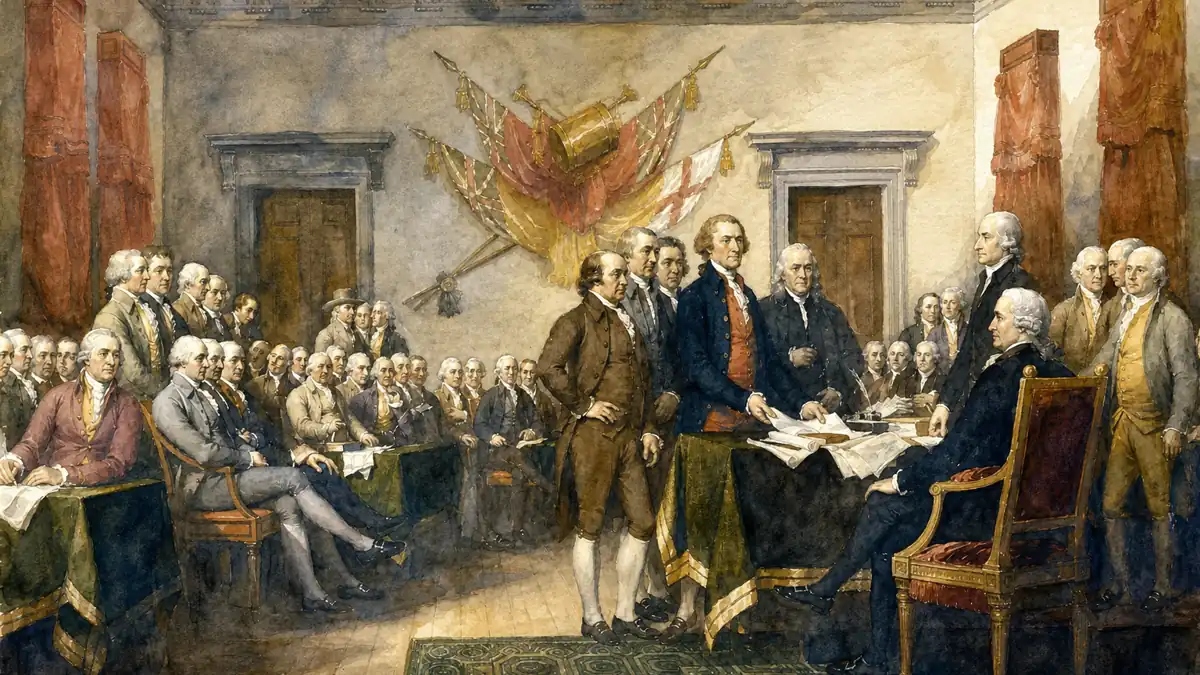
Some mistake a portrait called the "Declaration of Independence" — a 12x18 foot oil-on-canvas in the U.S. Capitol Rotunda — for America's founding fathers all signing their declaration of causes on the 4th of July 1776. However, the single most recognized and historically iconic image to ever capture the birth of the nation never actually happened. Signing the Declaration of Independence at 520 Chestnut Street in Philadelphia, Pennsylvania wasn't a single, dramatic moment comprised of 56 delegates gathering from 13 colonies. It was a scrappy group of infighters, defectors, proponents, detractors, and conscientious objectors straggling in over the course of 35 days. Despite their patronage to Enlightenment ideals, or risking their lives and fortunes for self-governance, their private correspondences reveal their truer intentions, shaped their colonies fate, and have and continue to forge the steel in the soul of America.
Abigail Adams to John Adams, 31 March 1776:
…I long to hear that you have declared an independency, and by the way in the new Code of Laws which I suppose it will be necessary for you to make I desire you would Remember the Ladies… If perticuliar care and attention is not paid to the Laidies we are determined to foment a Rebelion, and will not hold ourselves bound by any Laws in which we have no voice, or Representation.
John Adams to Abigail Adams, 14 April 1776:
…As to your extraordinary Code of Laws, I cannot but laugh… Depend upon it, we know better than to repeal our masculine systems.
And so it was that a five-man drafting called the “Committee of Five” began debating what Thomas Jefferson called his "expression of the American mind" on June 28; submitted it to Congress on July 4; to which 56 delegates finally and at long last offered their signatures by August 2. What transpired in those 35 days is not generally storied in America's folklore, but defined by our distrust of institutions, ideological polarization, and an intense disdain of established central authority. In 1776, those attitudes were directed toward the British Crown and Parliament. In 2026, they're directed by some toward the U.S. government—and the people of the United States of America.
A record-high 80% of U.S. adults feel the country is greatly divided on important values, according to Pew Research Center's "American Trust in One Another." A dynamic not lost on the Continental Congress. One-fifth of the delegates who initially opposed independence were replaced, and John Dickinson — who ironically coined the phrase “By uniting we stand, by dividing we fall!” — declined to sign at all. Patriots wanted independence; Moderates hoped for reconciliation; and Loyalists opposed separation from the Crown. The lyrical introduction to the Declaration of Independence according to Jon Meacham “arguably the single most profound sentence ever writ in the English language,” didn't just create a nation. It was an irrevocable divorce decree and masterful prenup designed to dissolve the political bands to which the British colonies were beholden; to raise themselves to an equal station to which the Laws of Nature and of Nature's God entitled them; and to declare their causes which impelled them to the separation.
Taxation, representation, tyranny, civil liberties et. al, Thomas Jefferson’s original draft of the Declaration began by strongly condemning the British crown for supporting the slave trade calling it “a cruel war against human nature.” That sentence was rejected from the original draft by the Committee of Five which went on to declare:
…We hold these truths to be self-evident, that all men are created equal, that they are endowed by their Creator with certain unalienable Rights, that among these are Life, Liberty and the pursuit of Happiness.
That “the unanimous Declaration of the thirteen United States of America" was cobbled together by a 33-year-old plantation owner; master to nearly 700 slaves over the course of his lifetime; and a new exhibit at Monticello that affirms Thomas Jefferson sired at least six children that he indentured into slavery. Therein lies the American Contradiction.
The U.S. Constitution (1787) established federalism; three branches of government, separation of powers; and the architecture of a republic. North Carolina refused to ratify until the first ten amendments (Bill of Rights) were guaranteed — freedom of speech, freedom of religion, freedom of the press et al. George Washington wrote to Martha from Philadelphia during the Constitutional Convention of 1787, uncertain whether the republic they were building would hold. "I almost despair of seeing a favorable issue to the proceedings of our convention, and do therefore repent having had any agency in the business." The newly christened U.S. Constitution was barely dry before it drew blood.
Severely harassed by the new and improved free speech during the second presidential rematch, one newspaper syndicated across the nation’s now 24 states: "'Ought a convicted adulteress and her paramour husband be placed in the highest offices of this free and Christian land?” A lapse in legal oversight left General Andrew Jackson and his wife vulnerable to impertinent insinuations during the 1828 presidential election, a day in time when mere gossip and rumor was considered exculpatory evidence in legal proceedings. Rachel Jackson’s first marriage; an administrative failure to have that annulment registered prior to marrying Jackson; even the death of Lyncoya Jackson — a Creek Indian boy adopted by the Jackson’s who died that year of tuberculosis — was all fodder and fair game feeding the nation’s new sensationalist news cycles. That it coincided with her passing just 8-weeks ahead of Jackson taking the oath of office as the 7th President of the United States can fairly be called the first casualty of the presidential election cycle. Jackson’s policies driving the mass displacement and deaths of approximately 100,000 Indigenous Peoples from their ancestral homelands whilst in office notwithstanding.
If sedition was a common law offense in England used to prosecute critics of His Majesty’s government, it was sole catalyst to the First Amendment. Anyone who published, wrote, or even spoke words that brought King George III or his government into contempt during the American Revolution faced heavy fines, 2–4 years in prison sentences, and transportation to a penal colony for 7 years.
Still, the eerily similar Alien and Sedition Acts signed by President John Adams made it a federal crime to publish "false, scandalous, and malicious writing against the U.S. government, Congress, or the President.” Crafted to suppress political speech, the law in principle ran afoul of the nation’s First Amendment and is alive and well today. Cut to the FCC of targeting ABC, CBS, et al. by penalizing media outlets; threatening the revocation of broadcast licenses; coercing media companies to discipline or terminate employees who critique the presidency. Abigail Adams, from across the centuries: "Men are Naturally Ridiculous."
“Men are Naturally Ridiculous.”
Enter First Lady Edith Wilson who kept Woodrow Wilson's incapacitation from a stroke from 1919–1921 a veritable secret; managed the executive branch's business in secrecy; and acted as a curtain between the president and his cabinet and the people. The sole conduit between the chief executive and his cabinet, "I myself never made a single decision regarding the disposition of public affairs," she wrote. Her husband called her 'Mrs. President.'
To wit, while the Great Depression (1929–1939) was driving unemployment to 23 percent, and contracting the global GDP by 15 percent, Franklin D. Roosevelt's stimulus package called the Three R’s (Relief, Recovery, Reform) was running afoul of the founder’s core ideas on limited government intervention in the free market. By launching massive federal programs to fix the economy, the New Deal challenged traditional American laissez-faire economic principles by expanding the federal government's role in daily life. Critics called it socialism. Others fascism. Speaking at Howard University on October 26, 1936, Roosevelt drew the first battle lines of the forthcoming civil rights movement: "Among American citizens, there should be no forgotten men and no forgotten races."
If First Lady Eleanor Roosevelt was the first to defy segregation laws in Birmingham, Alabama, by sitting in the designated "colored" section during the Southern Conference for Human Welfare, that challenge was timed to coincide with FDR's need for southern support of his New Deal agenda. When police ordered her to move, she simply placed her chair in the aisle between the black and white sections, apprising the nation of her platform, and presaging the pre-civil rights movement.
From the newly erected East Wing, Eleanor Roosevelt clarified “Four Basic Rights” she believed every citizen in a democracy must enjoy: equal education, work for equal pay according to ability; justice under the law; and participation in the making of laws by use of the ballot. Often summarized as the right to work, food, clothing, and shelter, the first lady took FDR's “Four Freedoms” from platform to application.
As the longest-serving First Lady and a fierce human rights advocate, Eleanor Roosevelt’s legacy "cut both ways,” simultaneously championing unprecedented civil rights and woman's activism while maintaining complicated, outdated views on race and colonial dynamics.
Nearly one million African Americans served in a segregated U.S. military during WWII, fighting fascism abroad while facing racism at home. On the other side of the world, the United States was detonating two atomic bombs over Hiroshima and Nagasaki, vaporizing some 200,000 Japanese civilians. Instantaneously.
Harry Truman's "Dear Bess" letters, written during the 1945 Potsdam Conference, are the most candid presidential correspondence of the 20th century. "It was my turn to feed 'em at a formal dinner last night. Had Churchill on my right, Stalin on my left... The old man loves music... I'm sick of the whole business — but we'll bring home the bacon."
My first interest is U.S.A., then I want the Jap War won... Then I want peace — world peace and will do what can be done by us to get it.
World War II transformed the United States from a regional power into the world's dominant superpower by 1945, becoming the world's most powerful military and “leader of the free world.” But for the 70–85 million deaths, and the rise of the US and USSR as superpowers, it was the dawn of the nuclear age that continues to resonate today. During the thirteen days of the Cuban Missile Crisis, John F. Kennedy said, “It shall be the policy of this nation to regard any nuclear missile launched from Cuba against any nation in the Western Hemisphere as an attack by the Soviet Union on the United States, requiring a full retaliatory response upon the Soviet Union.”
As of July 4th 2026, the United States continues to find itself in a familiar echo chamber. The conflict with Iran — increasingly viewed as a proxy war with Russia — mirrors the geopolitical brinkmanship Kennedy navigated in October 1962. Moscow provides the intelligence, the drone and missile technology, and the economic lifeline. Tehran provides the theater.
And therein lies the price, influence, pressures, strategies, and compensation package of Camelot and all “First Women: The Grace and Power of America's Modern First Ladies.” Kate Andersen Brower wrote and we agree: "Without the strength, support, and sheer star power of their wives, these men could not have reached the pinnacle of American politics.” Gore Vidal cites Jacqueline Kennedy in 'Palimpsest:' “I know my husband's unfaithful… but at least he's not sleeping with boys.” Principles don’t change. The players do.
First Lady Betty Ford went on-air to discuss pre-marital sex, breast cancer, abortion, and her own experience with a recent mastectomy on CBS 60 Minutes, but it was her reference to illegal drugs that caught the nation’s attention. "I'm sure they've all tried marijuana," Betty confides to Morley Safer in 1975 about her children. "I think if I were a teenager today, I probably would try it.” Her radical transparency won over the people while her husband’s approval rating plummeted. "I'm President of the United States and I can't control my own wife." Betty put it this way: "Being a lady does not require silence.”
In their finest hour, the first lady wields her influence. Often called the “First Lady of the World,” Eleanor Roosevelt — in what some have called a lavender marriage — held that love is a reflection of respect, and if a succession of five US presidents including — Eisenhower, Kennedy, Johnson, Nixon and Ford — feared that abandoning South Vietnam would damage American prestige; diminish the credibility of US commitments to other allies; or be perceived in any way as a victory for Communism they hadn’t met Nancy Reagan. "I more than love you," Ronald Reagan wrote. "I need you." The man who faced down the Soviet Union at Reykjavik kept his nerve “because of the woman who waited for me across the dinner table.”
Presaging America's 250th birthday, the heir to King George III stood on the floor of the United States Congress this spring and blessed the revolution his ancestor lost. Charles III came not to relitigate 1776 but to ratify it. "The Founding Fathers," he told the chamber on 28 April 2026, "were bold and imaginative rebels with a cause."
He praised NATO; called the defense of Ukraine a moral obligation; and warned against inward-looking nations — all with the careful deniability of a constitutional monarch who technically has no politics. King Charles III received 12 standing ovations. At the state dinner that followed, Trump said: "I've never been able to do that."
Touché. The first British king to ever address the U.S. Congress began, "we can perhaps agree that we do not always agree." His former mistress, consort, and now wife Queen Camilla attended the session as the fifth great-grandson of George III schooled the U.S. Congress on the tenets of the Magna Carta. The majority of the U.S. Supreme Court will appreciate the otherwise originalist intent to understand that the royal charter of 1215 sealed by King John of England at Runnymede was the first and foundational legal precedent for the need to limit executive power and establish due process. That it passed to Enlightenment thinkers who added reason, and onto the founders who gave it political context, is a Natural Law taking shape.
For 250 years, the United States has been litigating the belief that all men are created equal — entitled to life, liberty, and the pursuit of happiness — which was born of an open wound that has never fully healed. With every expansion and course correction, the country reconvenes at Independence Hall on Chestnut Street to argue their corner. The nation wasn't created to achieve consensus. The founders purposely fostered debate, and the collision of 348 million Americans' faiths, contentions, passions, convictions, and politics isn't a failure of the American experiment. It is its civic, constitutional, and cultural proof. The institution of America wasn't designed as a democracy. At its finest, it is the manifestation of a working republic.
That Dolley Madison saved the portrait of Washington from the burning White House in 1814; single-handedly preserved the visual symbol of the republic while her husband fled; literally invented the role of national hostess as a diplomatic instrument using the dinner table as foreign policy; and lent her surname rather intentionally to Madison Hemings, who, for the record, went on to state his position rather unapologetically in the Pike County Republican in an article entitled: “Life of the Lowly:”
… But during that time my mother became Mr. Jefferson’s concubine, and when he was called back home she was enciente by him. He desired to bring my mother back to Virginia with him but she demurred. She was just beginning to understand the French language well, and in France she was free, while if she returned to Virginia she would be re-enslaved. So she refused to return with him. To induce her to do so he promised her extraordinary privileges, and made a solemn pledge that her children should be freed at the age of twenty-one years. In consequence of his promises, on which she implicitly relied, she returned with him to Virginia. Soon after their arrival, she gave birth to a child, of whom Thomas Jefferson was the father. It lived but a short time. She gave birth to four others, and Jefferson was the father of all of them. Their names were Beverly, Harriet, Madison (myself), and Eston—three sons and one daughter. We all eventually became free agreeably to the treaty entered into by our parents before we were born.
The city Jefferson built on a swamp has been draining ever since, and the Daughters of Liberty’s devotion, silence, advocacy, regrets, and stunning absence to protocol and tradition has and continues to speak truth to power in a way men are only coming to understand. And we believe, dear readers, that this is where and when their voice first emerged. 520 Chestnut Street, Philadelphia, PA 19106. At the conclusion of the Constitutional Convention, Elizabeth Willing Powel — who for all 116 days stood come rain or shine outside of Independence Hall — cornered Benjamin Franklin and asked: "Well, Doctor, what have we got? A republic or a monarchy?”
Franklin replied. “A Republic, madam. If you can keep it.”