CHARLATAN
The Exposé of Politics & Style
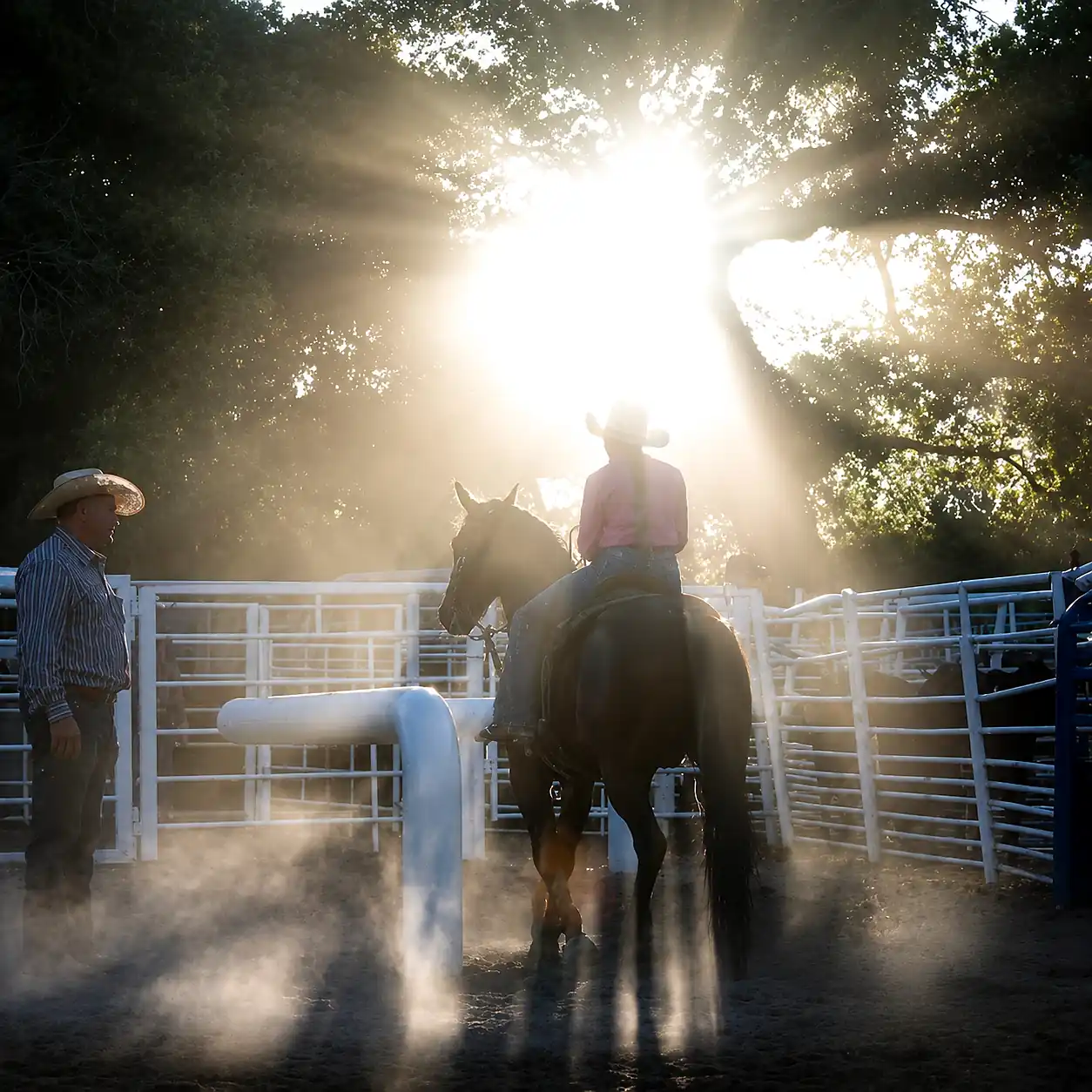
Our ancestors began celebrating the 4th of July in Gunlock well over a century ago. Today the rodeo grounds in the tiny Southern Utah town are the welcoming spot for ranchers and riders from miles and miles around. Highly independent and self-sufficient, these participants are the bedrock of America, fiercely patriotic and proud to be Americans. Their voices ring with conviction as they sing "The Star-Spangled Banner."
The day starts early on the 4th of July in Gunlock with the sunrise service of flag raising and a patriotic address by a town luminary. While attendance is not mandatory, the town is rousted out of bed by the blaring horns of the town's fire truck which continues unabated for long enough to make everyone wide eyed and upright. The flag raising ceremony at the community center is followed by a breakfast served by the town leaders in the tree-shaded town park. The "mayor" makes the pancakes; the fire chief is in charge of not burning the bacon; and the water master scrambles eggs by the dozens. Everyone volunteers to help with the setup and cleanup. The camaraderie and pleasure of old friends, incoming guests, and coming events is a quintessentially American experience.
The Gunlock rodeo begins toward evening to avoid the blistering July sunbaked days with a record temperature of 117 degrees on July 5, 1985. Roping calves and riding terrifying bulls with dispositions of rage and reprisal is the high adventure contrasted with the silk-shirted rodeo queen and her court who ride in proud display. The highlight for many is the barrel racing competition. The rodeo bleachers are filled with children, and their special events include the chicken chase and boot race. For teens and others who think they are invincible there is the mule/greased watermelon competition. With two young riders per mule, a baker's dozen of mules at a time, they ride to the end of the arena, grab a greased watermelon, and make a valiant attempt to double back to the starting point. It is an amusement seldom surpassed or completed.
The 4th of July parade participants — most in red, white and blue — march or wave from floats draped with banners, and toss wrapped candies into the crowds of onlookers seated along the parade route. Gunlock has only one Main Street, and that is the route.
On Sunday the church is filled with these same folks, albeit now dressed in their Sunday Best, who begin to sing a song colloquially known as “America:"
My country, 'tis of thee, Sweet land of liberty, Of thee I sing; Land where my fathers died, Land of the pilgrims' pride, From ev'ry mountainside Let freedom ring!
The church goers know of the Pilgrim's pride and from whence they came, as the ancestral lines of the townspeople of Gunlock are well researched. The documents point directly to the deck of the Mayflower as it reached the icy shores of Cape Cod, far off course from Virginia, the intended destination. The Mayflower Compact of 1620 was signed before Captain Standish took men ashore to explore. The Compact — the first document by free men to govern themselves — stated their purpose in practicing freedom of religion and bringing Christianity to the natives. It gave the briefly stated laws needed to bring safety and freedom to the new community. As a free people of good character, they would labor for themselves and their families in a community of order and respect for others. The Bible was the guiding source and Elder Brewster the leader of the congregation. Those not Separatists were willing to follow the Golden Rule, use self-control and sacrifice for the good of all. They did not need a king to tell them what to do.
The names of the Mayflower Compact signers and all the other men who survived that first winter are found on the Gunlock genealogies including Alden, Brewster, Allerton, Howland, Cooke, Browne, Mullins, Warren, Rogers, Eaton and Fuller and others. Of the original 102 Pilgrims, only 22 men and 5 married women with 25 children, many now orphans, survived the first winter of "The Great Sickness.”
On March 16 Samoset arrived, walking into the group of Pilgrims and greeting them in English he had learned from English fishermen who had come to the area. Samoset proved to be a miraculous gift to the Pilgrims in showing them ways to fish, hunt and plant corn, and how to deal with the natives. Samoset brought his English-speaking friend, Squanto, who chose to live with the Pilgrims and show them how to survive in this wilderness. On April 5, 1621 the Mayflower sailed back to England and not one of the Pilgrims chose to leave. By Fall the corn had been harvested; the meeting house and the homes had been finished; and a store of wood was ready for winter. It was time for Thanksgiving for the blessings received from their Creator. William Brewster, the much-honored religious leader of the Pilgrims, presided over the celebration. Chief Massasoit was invited and came with 90 braves and a gift of five large deer to roast. The days of prayer and thanksgiving lasted three days with singing and prayer, feasting, and dancing.
William Bradford, 31, was elected to lead the settlers. As an orphaned teenager, he had met William Brewster in England before the move to Holland. So deep was their friendship, Brewster treated him as a son. For the next 30 years, Bradford was elected as governor of the colony. His journals have been invaluable sources for understanding the daily achievements of these men and women, filled with purpose, creating a life of freedom for following generations. They worked together with great faith and hope and power. Captain Christopher Jones of the Mayflower returned to America bringing his son, Teague, and in a scenario hard to imagine Teague later married the daughter of Samoset. This genealogical line can also be found in Gunlock.
With great success the new colonies filled with families of hard-working men and women of faith who were dedicated to freedom. They sent home to England barrels and barrels of furs and wood along with glowing reports of the freedom of worship and self-government and open areas waiting for newcomers. Over the next 150 years, hundreds of thousands of people from England would cross the Atlantic to become a part of the colonial experiment, largely protected from the whims of the monarch by the wide Atlantic.
King George III changed that when he came to the throne in 1760 at the age of 22. Poorly counseled by advisers, he began instituting a series of increasingly abhorrent acts. Continental Europe lived under civil law wherein the people can do only what the monarch designates, subservient to human rulers who grant to the people rights and powers. England was governed under Common Law, which rests on the premise of individual rights and liberties. While the king gave privileges and power to his chosen Lords, Counts and Barons, all pursuits except those forbidden by law were allowed to the people. This vast difference had been celebrated since the signing of the Magna Carta in 1215 when the English Parliament was instituted. As the second English king from the German line of Hanover, King George tightened his despotic grip and imposed martial law on the American colonies (Coercive Acts 1774). Reacting with written pleas for redress, King George refused to read or even consider the documents and imperiously slapped on another tax. Serious trouble was brewing.
The Stamp Act, Boston Tea Party, Intolerable Acts, Townshend Acts, and Battles at Lexington and Concord all led up to the Declaration of Independence. Delegations were sent to England to humbly ask for conciliation. However, the writ of reply angered Thomas Jefferson, John Adams and Benjamin Franklin who made up the committee assigned to write the Declaration.
The Declaration of Independence has been called the greatest document in political history. Only 1320 words long, it first gives the source of our government; "The Laws of Nature and of Nature's God." Under these laws "All men are created equal" which makes them equal in their rights. Moral laws give rights in worship, family, property, learning, and justice among others. Government is given for the protection of these rights, distilled into the description of life, liberty, property and the pursuit of happiness.
Jefferson, adroitly, included in the writings that the country would be governed in representative form with the consent of the governed. Government must be limited to only the powers delegated by the people, and the brunt of governing would be done locally and within the states, local decisions managed first-hand by the people most affected.
In the 250 years since the Declaration serious inroads have been made, the worst cast in the form of the Commerce Clause. U.S. Supreme Court interpretations have effectively granted the federal government near-limitless power, erasing the original constitutional vision of limited, enumerated powers. This broad reach enables federal overreach, infringes on state sovereignty, and dictates national standards over deeply local issues.
Often described as a silent member in Congress, Thomas Jefferson in the Committee of Five was frank, explicit and decisive. Of the 17 days he spent writing the Declaration of Independence, most of that time was spent crafting, interjecting, and perfecting his four principles of political wisdom. Jefferson’s philosophical foundation rested on four core principles of governance and natural rights. These ideals—Equality, Unalienable Rights, Consent of the Governed, and the Right to Alter or Abolish Tyranny laid the foundation of the nation.
The powers of government must not be concentrated but divided into the legislative, the executive and the judicial branches, not to be combined, but to work as checks and balances to protect the citizens of the country from despotic governmental power. Government is thereby chained and liberty preserved. 2. Federal power is limited and local and state governments are given all unenumerated powers. 3. Taxation without representation is unlawful, and people cannot be taxed without their consent. 4. The powers of self-government could be delegated by vote of those to be represented to their representatives.
A decade on, the Revolutionary War had been fought and won, and the Framers of the Constitutional Convention invoked Jefferson's principles to draft the Constitution of the United States of America.
Freedom depends on knowing and living the principles that bring peace not war, prosperity not poverty and freedom not slavery. The Bible succinctly says this begins with loving God and your neighbor and acting with self-restraint. For mutual protection, rules are made to keep order. The blueprint for a free society rests on a free people of good character; self-reliant, willing and anxious to help others in times of need; and who work to bring goodness, truth, and beauty to the lives of their families and communities. As the nation turns 250, join us this year on the 4th of July in Gunlock. Come see it for yourself.

All the World’s a Stage
Make sense of the week's news.
Charlatan reviews the worldview.
CHARLATAN
The Exposé of Politics & Style