CHARLATAN
The Exposé of Politics & Style

Ten months before the Pentagon announced it would screen every service member 30 and older for low testosterone, President Trump signed an executive order reviving the department's 1789 name. Hegseth obliged, having new bronze plaques hung at the building's entrances himself, while the refit's cost estimates climbed past $50 million that Congress still hasn't signed off. Trump had previewed the reasoning weeks earlier, telling reporters in the Oval Office that "Defense is too defensive," and that the country had "an unbelievable history of victory" under the old name. The order itself, EO 14347, put it more formally: the "Department of War" name "ensures peace through strength," reflecting an "ability and willingness to fight and win wars... not just to defend." The testosterone program is what that permission looks like once it reaches the level of individual bodies. If the mission is war, not defense, the men fighting it are no longer patients to be maintained. They're instruments to be calibrated.
It is not the first time a military state has reached this conclusion.
In the spring of 1940, German medical officers handed out millions of methamphetamine tablets to soldiers preparing for the invasion of France. The drug was called Pervitin, sold openly in pharmacies and marketed as a stimulant. Doped up Wehrmacht troops marched and fought for ten straight days without meaningful rest, a chemically extended blitz that helped trap the British army at Dunkirk. One medical officer, testing the drug on his own men, called it "an excellent substance for rousing a weary squad."
It wasn't a black-market vice. It was policy — a state deciding that the fastest way to build the army it needed was to re-engineer the soldiers it already had, chemically.
The same regime, working through more legitimate channels, was pursuing a subtler version of the same idea. In 1935, the German biochemist Adolf Butenandt isolated testosterone, funded by the pharmaceutical company Schering-Kahlbaum. A year later he joined the Nazi Party on the same day he was named director of the Kaiser Wilhelm Institute for Biochemistry — a post that had opened up because its previous occupant, Carl Neuberg, Jewish, had been pushed out. Schering, the company that bankrolled the discovery, went on to build a forced-labor camp on its own factory grounds and enrich itself on property seized from Jews under Aryanization law. Butenandt got the Nobel Prize; Schering got the patent; Neuberg got erased. The machine was functioning exactly as designed.
Pervitin is a catalyst. Testosterone is the culprit driving sex, power, and the will to win. However, scientists are officials who can forget their problems at six o'clock in the evening. Politicians cannot and must not do that. For combined the drug triggering hormone is an appetite: a government looking at its own soldiers and seeing raw material to be optimized. Eighty-odd years on, a very different government has twigged on.
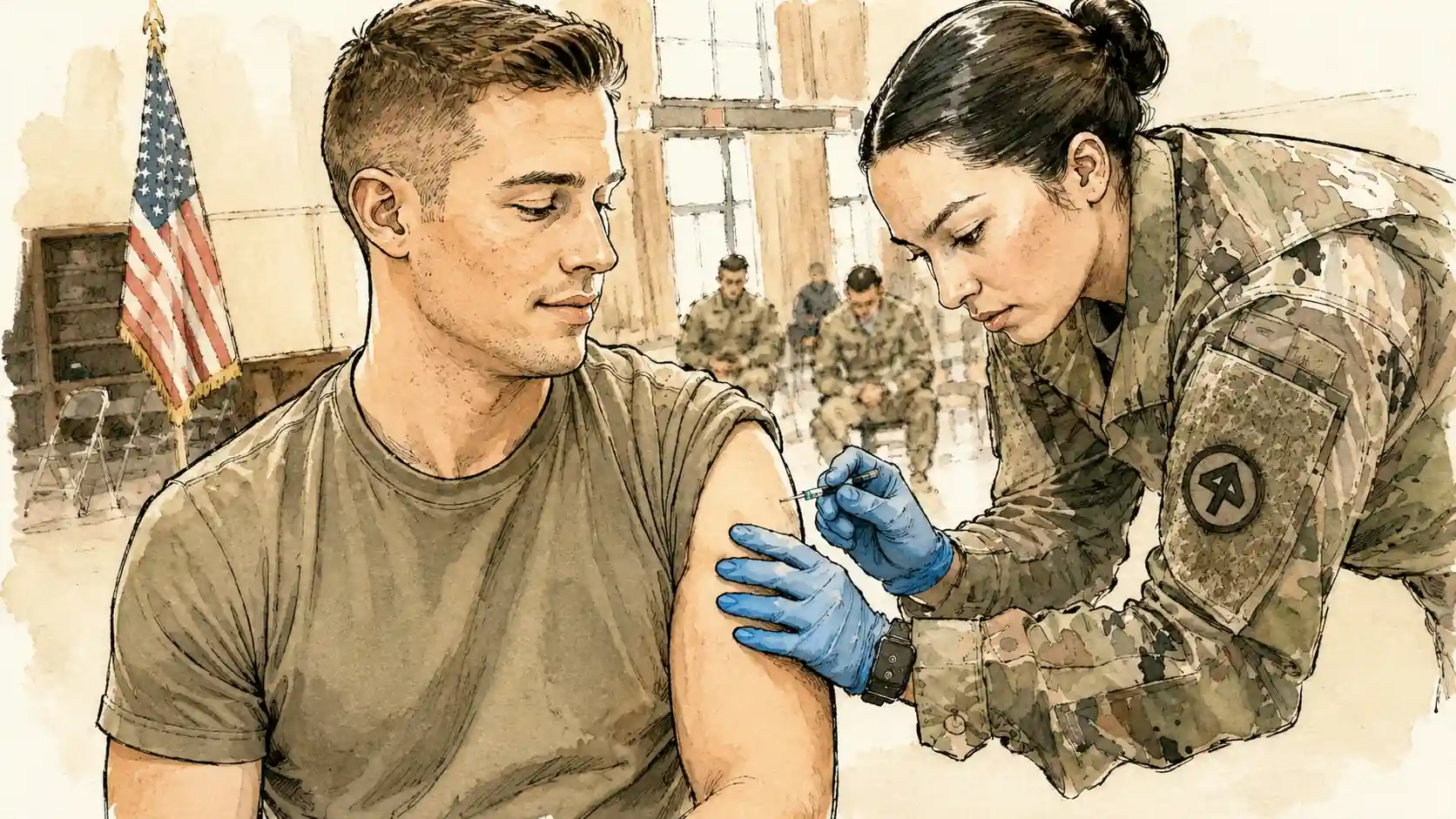
In July, Defense Secretary Pete Hegseth announced that every American service member 30 and older will now be screened for low testosterone as part of their annual physical — mandatory for the test, voluntary for the treatment that follows. He called it in a video posted to X, the "High-T Department." Troops who test low will be offered hormone therapy. Troops who don't ask won't get it. The Pentagon — the Department of War says the goal is a "decisively dominant fighting force."
While Wehrmacht doctors were chemically extending soldiers already being fed into a war of annihilation; Hegseth is running a peacetime health screening with an opt-in treatment arm. What connects the two moments isn't ideology. It's appetite — the recurring instinct of a state, any state, to reach for the body's own chemistry when it wants to maximize strength, and to mistake a hormone panel for a national character test. Hegseth, unlike the men who ran Pervitin through the Wehrmacht's supply lines, has left a paper trail explaining exactly what he means by it.
In The War on Warriors, published in 2024, months before he was sworn in to run the institution he now runs, Hegseth wrote that decades of diversity policy had left the military "effeminate." He argued that inclusion messaging made "white kids" feel unwanted. He wrote off women in combat roles in language that reads less like doctrine than eulogy: "Dads push us to take risks. Moms put the training wheels on our bikes. We need moms. But not in the military, especially in combat units."
This was not incidental phrasing. It is Hegseth's thesis. And in October, nine months into the job, he made it policy — ordering every combat fitness standard across every service raised to what he called the "highest male standard," telling a room of the military's top brass that if women didn't qualify, "so be it."
Read the book next to the memo, and the testosterone program stops looking like a health initiative and starts looking like the next paragraph in an argument Hegseth has been writing for years. Strength is gendered. Weakness is feminized. The fix, in his telling, has always been a return to some imagined biological baseline — and now the Department of War has a blood test to measure it.
The screening didn't arrive on its own, either. It landed inside a wider deregulatory current on the same hormone. Weeks earlier, the FDA had asked to strip long-standing safety and effectiveness warnings from testosterone product labeling and separately proposed loosening the prescribing limits that have governed the drug for decades — part of a push by Health Secretary Robert F. Kennedy Jr. and allied officials to make testosterone easier for doctors to prescribe. The Pentagon's program didn't invent this appetite. It found a captive population to feed it to.
Even doctors sympathetic to the screening are more careful than Hegseth was. Dr. Mohit Khera, the Baylor urologist who led an FDA panel on testosterone use in the military, told the BBC the logic behind screening is sound — low testosterone is common, and it's a real marker of a man's overall health. But he was equally clear about what the video omitted: young men on hormone therapy can become infertile, cardiovascular risk rises, and treatment is only appropriate for men who are symptomatic, not simply low on paper. "You have to be careful not to just give someone testosterone unless they do have some kind of symptoms," he said. None of that qualifying language made it into the Pentagon's press release, or Hegseth's video.
What about the women? Senator Tammy Duckworth, an Iraq War veteran, called on Hegseth to make hormone testing available to female troops as well. Representative Chrissy Houlahan, an Air Force veteran, was blunter, dismissing the whole program on social media as Hegseth's "latest culture-war obsession." Asked directly whether servicewomen entering perimenopause might be evaluated for hormone therapy of their own, the Pentagon was silent. A program built on the premise that hormones determine military fitness apparently only has one hormone—and one sex.
The Wehrmacht doctor who praised Pervitin never had to answer for what it would do to the men taking it long-term. There wasn't going to be a long term. Hegseth doesn't have that excuse. He is building a permanent policy on the promise that the right number, drawn from the right vein, will produce the fighting force he's been describing in book form since before he had the authority to order it.
He has already told us how he feels about trust, and what he thinks it costs. Writing about the years before he ran the place, back when the military still made room for the kinds of people his new fitness standards are built to exclude, Hegseth didn't call it progress. He called it a mistake: "our good faith was used against us."
The chemistry has gotten more precise. The instinct hasn't moved an inch. This time, the good faith isn't even being offered.
The man who renamed the department said as much himself, standing in the Oval Office the day he signed the order: "We should have won every war. We could have won every war but we really chose to be a very politically correct—wokey. We never wanted to win." Three weeks later, addressing the generals who'd carry out his new directives, he told them what came next: "We will be a fighting and winning machine.”

All the World’s a Stage
Make sense of the week's news.
Charlatan reviews the worldview.
CHARLATAN
The Exposé of Politics & Style