CHARLATAN
The Exposé of Politics & Style

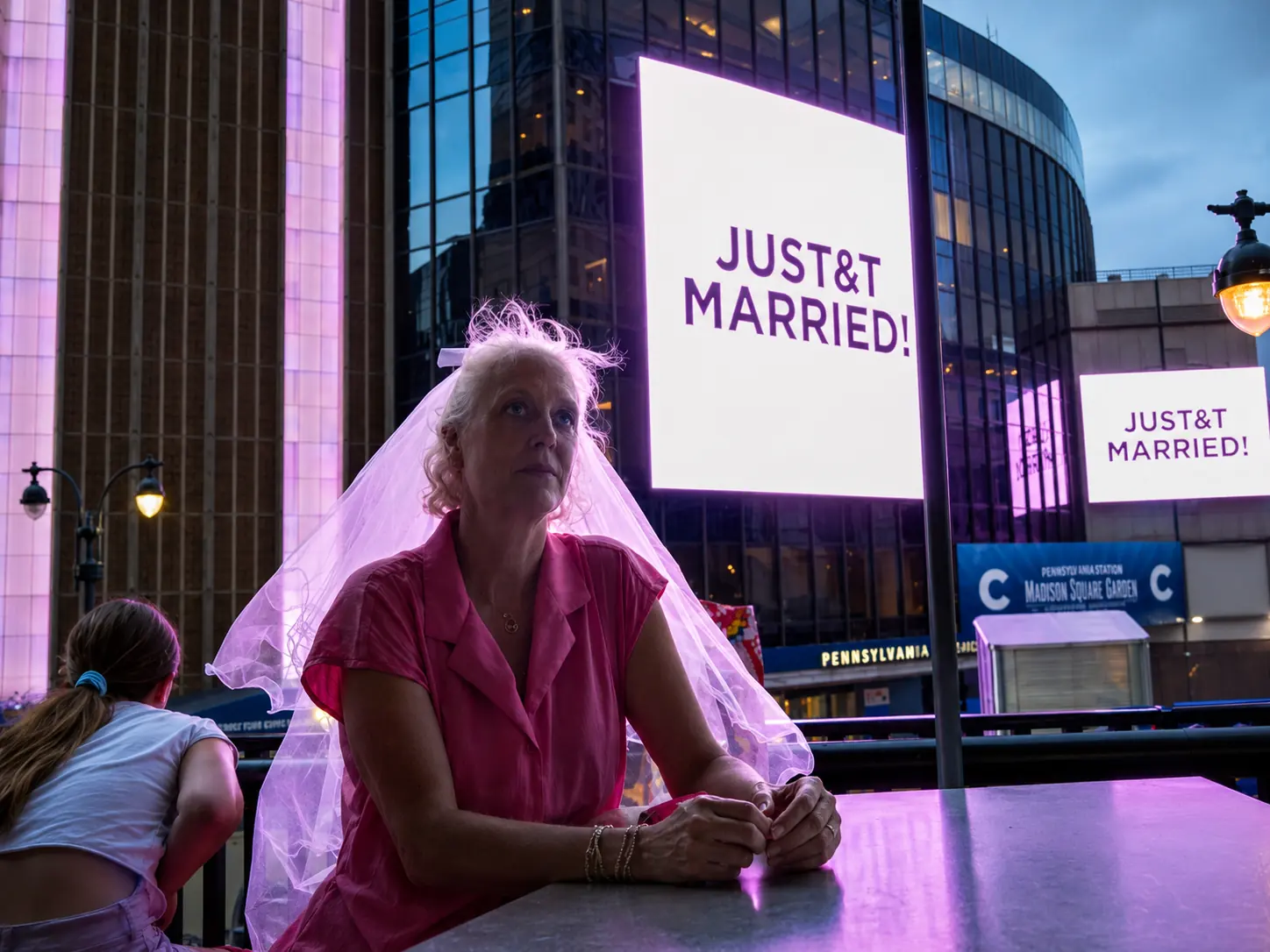
Madison Square Garden was closed to the public on July 3rd for a wedding no one outside a guest list of a thousand people had officially been told was happening. Attendees signed non-disclosure agreements. Phones were banned inside the venue, for guests, vendors, and security alike, and guests received watermarked invitations, individually traceable, designed so that any leaked photo could be run back to its source. A rehearsal dinner for roughly a hundred people was held the night before in the arena's own theater. Adam Sandler officiated and a marquee outside the Midtown Manhattan arena proclaimed “JUST&T MARRIED” once the deed was done.
By the time Taylor Swift and Travis Kelce were married, the operation surrounding their wedding resembled less a party than a hardened perimeter — NYPD briefings, Amtrak police coordination for the station beneath the building, a security memo circulated internally to law enforcement. Nobody builds that kind of apparatus to protect a private moment. They build it to protect an asset.
That's worth sitting with before getting to what the wedding meant—because the apparatus is the meaning. A thousand guests; a $6 million second home purchased years earlier in Kansas; tens of millions of dollars given away to charity in the run-up to the ceremony; a Christian Dior gown; strict no-gifts policy extended even to close friends — this wasn't a wedding scaled up from an ordinary one. It is a different category of event, and the couple at its center are not exceptions to how marriage works in America right now. They are the clearest possible expression of it.
That drop — from a norm to a minority experience in one lifetime — didn't happen because Americans stopped wanting to get married. Marriage did not become unpopular. It became unaffordable, unreachable, and — for a growing share of the country — beside the point. The institution didn't die. It moved.
There's a song for this. In 2020, Swift released "The Last Great American Dynasty," a track built around the real life of Rebekah Harkness, a Missouri-born divorcée who married into a Standard Oil fortune in 1947 and was, by the account the song draws on, mocked and ostracized by the old-money establishment of Watch Hill, Rhode Island, for the sin of arriving from somewhere else. Harkness threw loud parties, dyed a neighbor's pet cat green, and spent decades being talked about as an outsider who married her way into a world that never fully let her in. Swift bought Harkness's old house in 2013. The song, when it finally came, wasn't just about Harkness. It was about the mechanics of dynasties — how they're built, who gets let in, and who spends a lifetime being reminded that their entry ticket was marriage rather than birthright.
That's the actual story underneath the wedding coverage. Marriage in America has always done double duty as a romantic institution and an economic sorting mechanism. What's changed is the ratio. As the sorting function has intensified, the romantic one has become something closer to its cover story — the thing you talk about at the reception, not the thing the data explains.
Start with who marries whom. In 1980, an American man with a college degree had roughly a 17 percent chance of marrying a similarly credentialed spouse. By 2000, that had nearly doubled to 33 percent. The pattern holds, and strengthens, for women. This is what economists call assortative mating, and the plain-language version is simpler: the educated increasingly marry each other, concentrating income, credentials, and stability inside a shrinking set of households instead of distributing them across the population the way earlier generations' marriages tended to. A dynasty, in the Harkness sense, is just assortative mating with a house attached.
A dynasty, in the Harkness sense, is Assortative Mating w/ a house attached.
The divergence shows up even more starkly in what happens after the wedding. In 1980, divorce rates among Americans who'd ever married, ages 35 to 44, sat around 10 percent regardless of education level — a college degree bought you nothing in terms of marital stability. Three decades later, the picture had split in two. For Americans without a college degree, the divorce rate had doubled, to roughly 20 percent. For college graduates, it had barely moved. Marriage among the credentialed didn't just become more selective. It became more durable at precisely the moment it became less accessible to everyone else.
Money explains most of the gap directly, without much need for interpretation. Among never-married adults earning under $30,000 a year, 47 percent say not being financially secure is a major reason they haven't married. Among those earning $75,000 or more, that figure drops to 21 percent. The obstacle isn't a change of heart about the institution. It's the price of admission. And the attitudinal data confirms the class read isn't incidental: in one national survey, 45 percent of respondents with only a high school diploma agreed that marriage is becoming obsolete, compared with 27 percent of college graduates — a divide that tracked income far more closely than it tracked age, race, or politics.
Economists who study this divide are careful not to reduce it to a single cause, and the caution is warranted. Education delays marriage on its own — the longer someone stays in school, the later they tend to marry, independent of income. But delay isn't the same phenomenon as absence. What the research keeps finding is that education's effect on whether someone ever marries is much smaller than its effect on when and whom, while income's effect on whether someone marries at all is large, direct, and growing. Declining job prospects for lower-income men are frequently cited as a compounding factor: as men's earning potential in that bracket has eroded and women's independent earning power has expanded, one of marriage's traditional economic incentives — pooling risk between an earner and a dependent — has simply weakened for a large share of the population. Marriage stopped being the mechanism by which working-class households built stability, because for many of them there was no longer a stable earner on hand to build stability around.
The dynasty, in other words, isn't just marrying itself. It's the last remaining place where the old economic logic of marriage — that combining two incomes and two credentials produces more security than either alone — still reliably holds.
None of this makes marriage a scam, exactly. Though it's worth noticing what does get sold in its name. Weddings generate an estimated $300 billion a year in the United States, at an average cost north of $35,000 — a price tag that has climbed steadily even as the population able to comfortably pay it has narrowed. The industry markets the same mythology to everyone: the dress, the venue, the promise of a day when your life visibly changes shape. What it doesn't advertise is that the mythology and the demographic reality have quietly come apart. The spectacle gets sold widest to a population that can least afford the thing it's a spectacle of.
Which brings the story back to Madison Square Garden. Nothing about Swift and Kelce's wedding was aberrant. It was legible, once you know what to look for — the security, the NDAs, the traceable invitations, the charitable giving timed to precede the ceremony like a tithe paid to public opinion before the private event. This was a marriage between two people whose combined economic security made the decision to marry essentially unconstrained by the forces that keep 62 percent of 25-to-34-year-olds unmarried today. That is not a coincidence of celebrity. It is the mechanism working exactly as it now works at its most visible extreme.
Rebekah Harkness spent her life being reminded, in small cruelties, that she had married into a dynasty rather than been born to one. Watch Hill eventually forgave her, as the song attests, on account of the money. That's the arrangement, unchanged across seventy years: money buys entry, entry buys forgiveness, and the ceremony that marks the transaction is called love. Somewhere under a thousand guests and a no-phone policy, that arrangement was renewed again on July 3rd, in front of witnesses who'd signed away their right to share, describe, or ever achieve it.

All the World’s a Stage
Make sense of the week's news.
Charlatan reviews the worldview.
CHARLATAN
The Exposé of Politics & Style