CHARLATAN
The Exposé of Politics & Style
The world is coming to America for Soccer. I'm flying to London to sleep on a sidewalk.
This is not a cry for help.
It's the final exam in a twenty-year experiment inspired by the Smartest Man I Ever Met.
I have one item left on my Sports Bucket List. The secret? Every “impossible” ticket fell the same way: bought hours before kickoff, once hype bled out and reality set in. My wife's description of my method is not suitable for publication, though eventually she came around. The system was inspired by a Nobel Prize Winner in Economics.
It started with baseball.
My Dad's last words: “I never saw the f***ing Red Sox win the World Series.” I took on his burden as a challenge. When I finally attended the Series in 2007, Dad was there in Spirit. My Sports Bucket List was born. One by one they fell: the Stanley Cup, Final Four, Mint Juleps at the Kentucky Derby, Moët at the Paris Olympics, Chivas with the Bush family at The Ryder Cup.
The pièce de résistance? Super Bowl LI. Fifth row. Midfield. Marky Mark seated behind me. I watched Tom Brady lead the greatest comeback in football history from close enough to see the panic on Bill Belichick's face.
Only one Bucket List item remains. The World Cup? As John McEnroe once famously shouted: You Cannot Be Serious! To the five billion who will tune in to the World Cup, this message is for you: Nil-nil is soooooo boring. 40-Love is much sexier. I'm going to Wimbledon.
The Smartest Man in the Room
A Fortune 500 CIO, I thought I was pretty damn smart. Then we hired Myron Scholes, who won the Nobel Prize in Economics for a discovery that changed the financial world.
The options market is where the Smart Money lives. Where the real geniuses of Wall Street operate. Myron sat at the top of that world.
The Black-Scholes model — developed with Fischer Black in 1973 — is the Rosetta Stone of modern finance: the framework that made it possible to price options contracts. I had revered this man since I was an undergrad. And now he needed my help.
Invites to meet Scholes were scarce. Investment pros begged to get in but Fanboys were turned away. In the room: the CEO, basking in the glow of his new hire. The stoic Chief Investment Officer. Myron. The A-list. And me, trying to project competence.
Myron lectured for twenty minutes — intrinsic value, what an option is actually worth; time value, the premium charged for optionality. As expiration approaches, time value bleeds out. What remains is intrinsic value alone. In layman's terms, time runs out for the seller before it runs out for you as a buyer. That's the whole game.
He stopped. My head was spinning. All eyes turned to me. I couldn't think of anything profound. Instead, I said it reminded me of the ticket marketplace.
Three seconds of silence. The longest three seconds of my professional life. I checked the CEO's face. He wore the expression of a man wondering whether his Tech Guy had just embarrassed everyone in front of a Nobel Laureate.
Then Scholes smiled. A small nod. I felt a joy usually reserved for his brainiac students at the University of Chicago.
My assignment: Analyze every price change on the options market — one million ticks per second. Find needles in haystacks. The toughest challenge of my career.
Stingray would eventually win an award for Best Risk Management System on Wall Street. I barely remember the award. What I remember is the lesson.
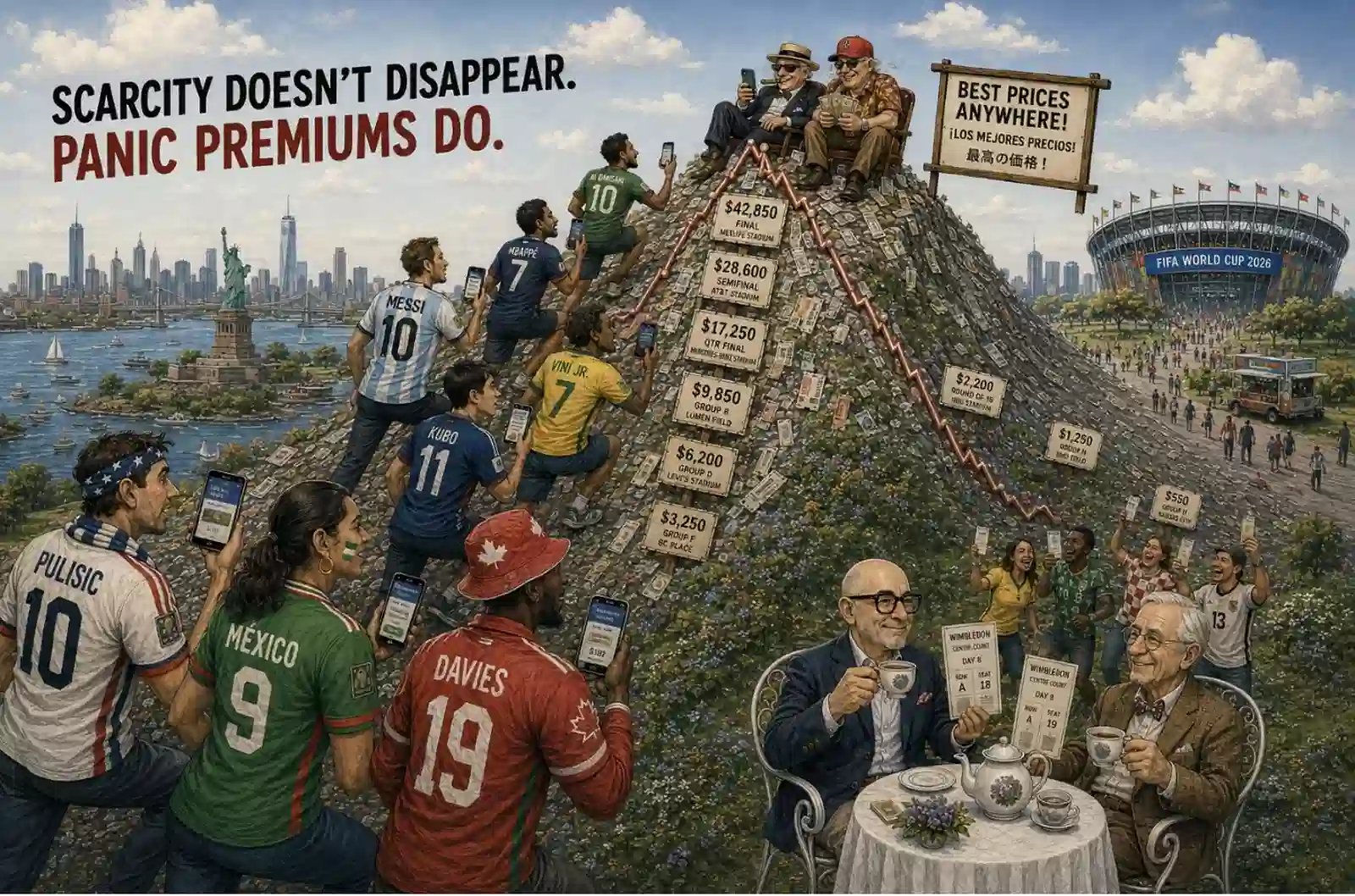
Scarcity doesn't disappear. Panic premiums do.
If You Call It Soccer, You Probably Shouldn't Be Hosting
The 2026 World Cup could serve as an exam question for Myron's students. America applied its unique talent for turning something elegant into a glorious logistics nightmare with a gift shop. We are as deserving of a World Cup as we are a Pope — which, as I wrote last week, is not saying much.
FIFA discovered what Fenway scalpers have known forever — ask “How much you got?” and watch the market sort itself out. They call it Dynamic Pricing. Seats to the Final reached $33k. The Cup was attacked by an angry press, indicting them for overpriced tickets, hotel price gouging, and transportation nightmares.
But here's what the headlines missed. Those asking prices are not transaction prices. Myron is surely smiling at the whole spectacle — these were pure time value, bloated with hype, hope, and panic. No intrinsic value to support them. The market was waiting for someone to blink. And with weeks still on the clock, nobody had to. Trump was asked about the $1,000 price tag on the US opener and said “I wouldn't pay it either, to be honest with you.” But now, right on schedule, the market corrected.
Relax. There's Still Plenty of Time.
The market split just as Myron's theory predicted. High intrinsic value games — the US opener, Brazil, the knockouts — are holding firm. Panic premium games — Cape Verde vs. Saudi Arabia, Algeria vs. Austria — are already down 20%, 30%, some approaching 40%. Sellers are now slashing prices to avoid eating worthless inventory. As of Friday, 75 matches still have tickets. Get-in prices for many group games are now dipping well below $200. So start making plans if the Cup is on your Bucket List.
As for me — I'll be sleeping on a sidewalk in South London. The numbers are far less complex than Stingray: sleeping out during the first week guarantees entry to the All England Club.
Wimbledon is everything the World Cup isn’t—steeped in tradition. This includes the oldest and most elegant ticketing in sport — you sleep out, you earn your seat for 35 pounds. The same way I got tickets for the sold-out Purple Rain and Synchronicity tours.
I'll be there at dawn. Earl Grey in hand.
One left on the list.
If you decide to go to the World Cup, wait.
Buy the ticket an hour before kickoff.
The market will tell you the truth.
Scholes sends his regards. FIFA won't send theirs.
As You Like It
The Week's Stocks, Risks,
Tips & Tricks on Wealth
CHARLATAN
The Exposé of Politics & Style