CHARLATAN
The Exposé of Politics & Style

On August 10, Mark Zuckerberg published a 6,500-word letter aptly titled "The Future is for Everyone" and simultaneously announced the release of Meta's Muse Glimmer—an open-weight 30B model released under Apache 2.0 for local/on-device agentic use. Keyword: Open Source.
The era's defining question is who gets access to superintelligence and what it gets directed toward — concentrated in a few institutions or distributed as a tool that empowers everyone. The notion that AI is so dangerous the only safe path is extreme concentration of power is inherently problematic; hoping an absolute power will benevolently provide for humanity has no track record of working. Zuckerberg doesn't name Nvidia, OpenAI or Google. He doesn't need to.
The case rests on a single analogy, repeated in three registers. One entity with superintelligent hacking capability breaks any system it wants; everyone with it hardens every system at once. One business with superintelligence monopolizes and calcifies its market; everyone with it keeps the market dynamic. One person with superintelligent legal counsel wins regardless of merit; everyone with it levels the field. It is not a technological claim. It is about balance of power — there is no such thing as a singular benevolent superintelligence.
The question predates Zuckerberg by two hundred and sixty years. Rousseau, writing against the very faction-checks-faction logic Madison would later build a republic on, warned that partial associations claiming to speak for the whole were the mechanism by which the general will got corrupted in the first place — that a coalition powerful enough to check other coalitions was still, by definition, a private interest wearing a costume in the public square. Zuckerberg's "balance of power" wants the confidence of Madison without answering Rousseau's prior objection: whose power, measured by what instrument, checked by whom, and who audits the auditor. The essay never names its own faction.
Give the essay its due first. Meta's decision to open-weight Muse Glimmer, and to promise the same for its more advanced Spark line, is not costless positioning — it is the one AI lab of comparable scale still willing to hand away model weights that OpenAI and Anthropic have kept behind an API since their founding premise shifted. That choice forecloses revenue, invites distillation by rivals, and puts real intellectual property in the hands of anyone with a GPU and no obligations to Meta at all. Whatever else the essay is doing, that specific bet is not free, and it is not rhetorical.
Behind the philosophy sit other, more specific policy moves. Meta will resume releasing open-source models "soon," now that Meta Superintelligence Labs is operational after a pause that followed last year's AI reorganization. Oversight shifts too: Meta's independent board, not Zuckerberg, will approve safety criteria for model releases and review compliance against them. The company is also proposing that frontier labs share intermediate training checkpoints with government before training completes, giving officials early access to harden critical infrastructure without slowing public release. And a new "Future Is For Everyone Fund" will seed support for the communities hosting Meta's data centers — alongside a fully private mode for personal AI agents, one even Meta could not access, modeled directly on WhatsApp's encryption.
"Meta's 2026 capital spending budget of $145 billion will be used largely to build data centers."
That is the number that outlives the philosophy. Every claim about individual empowerment, balance of power, and distributed superintelligence sits on top of a company spending $145 billion this year to build the infrastructure only a handful of firms on Earth can afford to build. The asymmetry is conceded outright: other labs are focused on building AI for companies, governments, and institutions, while Meta positions itself as the one company "primarily focused" on building it for individuals instead. Whether that positioning survives contact with Meta's advertising-driven revenue model is the argument critics reached for within hours of publication.
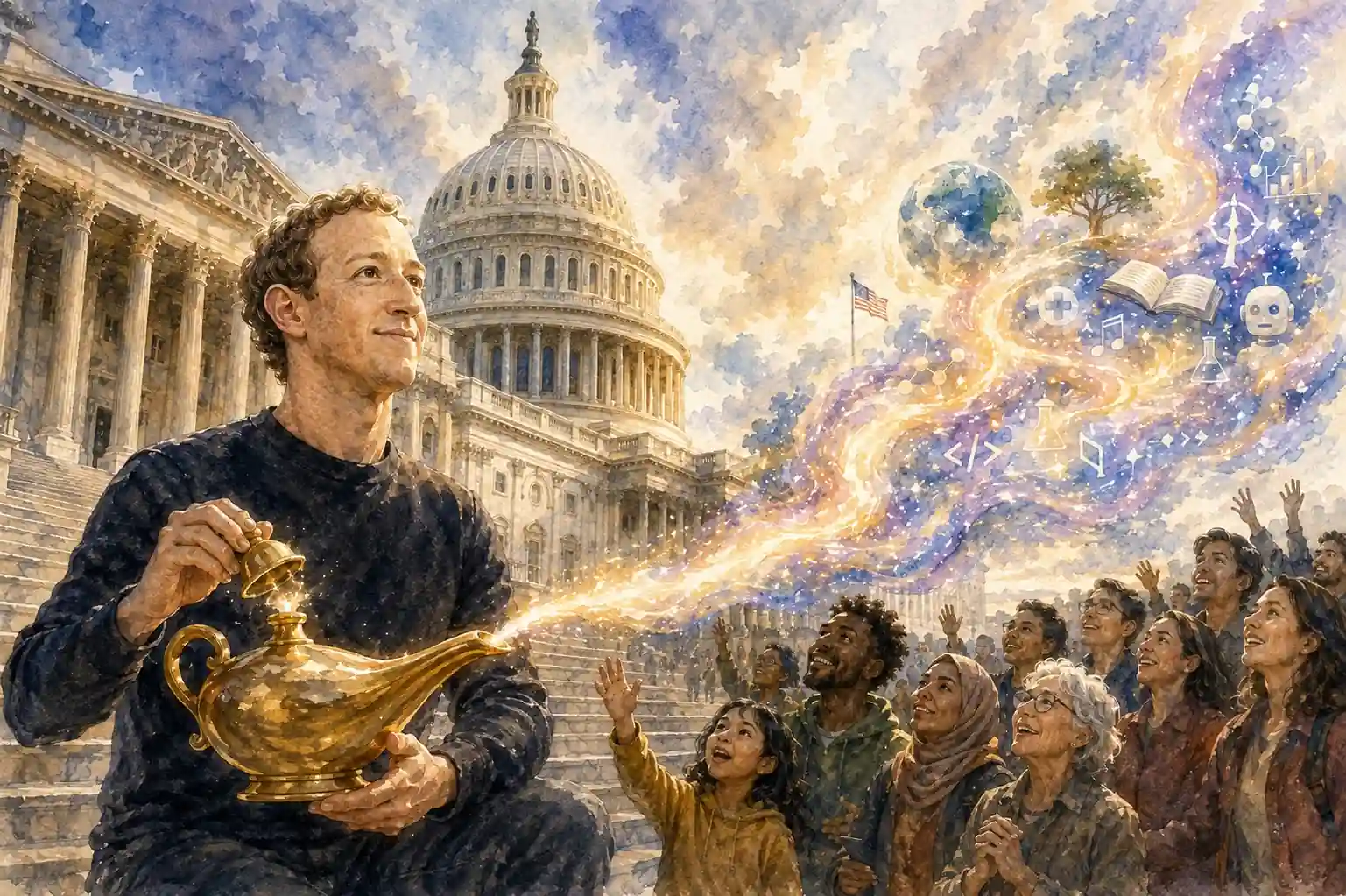
The independent-board provision is the essay's clearest tell. A founder-controlled company installing its own board as the check on its own founder is not a separation of powers — it is a single power grab wearing the vestments of an egalitarian one, a genie who writes his own rules for what the lamp is allowed to grant. The crowd on the Capitol steps gets the smoke and the light. The bottle stays in his hand.
This is not a problem unique to Meta. No governance structure — a corporate board, a congressional committee, an international body — fully escapes the regress of who oversees the overseer. That limit is real, and it would be dishonest to pretend Meta's arrangement is worse than everyone else's on those grounds alone. But a limit that applies to every structure is not an argument for choosing the weakest one. Meta had the option to build a board with outside members unbeholden to the founder's voting control, or to submit to external audit with teeth. It chose a board it already controls. The regress is universal. The choice was not.
On distillation and export controls
The geopolitical section is where the essay stops being philosophy and starts being policy advocacy. Export controls on silicon have successfully slowed foreign labs and should continue. Restricting American access to foreign open-source models is not an effective solution — the goal should be for American open-source models to be the best in the world. On the more contested question of whether rivals should be allowed to train on the outputs of US models: protecting the principle that you can learn from anything you can observe is how the world works, and the US cannot lead if it restricts itself here — a position that puts Meta at odds with Anthropic's own public complaints about DeepSeek.
About the Reception
The essay's sharpest reading came from Techdirt's Mike Masnick, who largely agrees with the philosophy and then dismantles the messenger. Masnick's point is not that Zuckerberg is lying about wanting a decentralized future. It's that Meta already ran this experiment and reversed course the moment centralization served it better — pointing to Threads, launched with public commitments to the open ActivityPub protocol, quietly shifted into maintenance mode once the platform had absorbed enough of the audience it needed. The precedent, Masnick argues, tells you more than the essay's language does: the alarm about concentration arrived at almost exactly the moment Meta stopped being the concentration of power that mattered. It is the strongest version of the critique this piece has been building from Rousseau — not that the argument is wrong, but that the party making it has already shown what it does when the balance of power tips its way.
A Word on Alignment
The essay's sharpest unnamed shot comes dressed as a definitional dispute. A rival model refused to help draft a letter to prospective parents at a school because it judged standardized testing unethical — the example offered of a defensive, centralized version of alignment: a company enforcing its own values under the name of safety. The alternative: alignment should mean an agent that serves a person's goals, not a company's — and if billions of people are using and scrutinizing personal agents, that scrutiny itself becomes the alignment mechanism.
It is a clean reframe. Every centralized safeguard gets rewritten as a threat, every distributed alternative as the safeguard itself. Whether that holds depends on a bet made two sections later — the one the essay is actually staked on.
Recursive Self-Improvement
Buried past the midpoint is the essay's most honest paragraph. A self-improving AI system optimizing its own compute efficiency could theoretically extract 100x or more intelligence from the same gigawatt — meaning a fraction of the world's hardware could command more effective power than everyone else combined, becoming the singular superintelligence the rest of the essay exists to argue against. The proposed fix is not a technical safeguard. It's a wager: that multiple labs reach recursive self-improvement at roughly the same time, and that their systems check each other the way competing interests check each other in a functioning economy.
This is the Enlightenment's oldest promissory note restated in gigawatts. Madison bet that ambition would counteract ambition, that no single faction could dominate a republic built from enough competing ones. Smith bet that self-interest, multiplied across a market, would produce an order no single actor designed or controls. Both bets required the same unproven premise Zuckerberg is now asking investors, regulators, and the public to accept on his timeline: that the competitors arrive simultaneously, that none gets far enough ahead to break the balance before the others catch up. Madison had centuries. Zuckerberg has a lead measured in months. The mechanism he's borrowing was built for a world that moved on the scale of legislatures, not training runs.
Rousseau would have asked the more basic question first: even if the genies arrive together, who, pray tell, is rubbing the lamp.
All the World’s a Stage
Make sense of the week's news.
Charlatan reviews the worldview.
CHARLATAN
The Exposé of Politics & Style