CHARLATAN
The Exposé of Politics & Style

Joe Kent — Director of the National Counterterrorism Center — resigned on Tuesday saying: “I cannot in good conscience support the ongoing war in Iran. Iran posed no imminent threat to our nation, and it is clear that we started this war due to pressure from Israel and its powerful American lobby.”
“It’ll be over with pretty soon,” Trump told reporters in the Oval Thursday, and then declared a wartime emergency to bypass Congress and push $23 billion in weapons sales to the U.A.E., Kuwait and Jordan; and the Pentagon requested an additional $200 billion in funding for the war. “Obviously,” Defense Secretary Pete Hegseth says, “it takes money to kill bad guys.”
Nearly three weeks into the 2026 Iran War, the “bad guys” et. al. have disrupted supply chains, food systems, financial markets, and sovereign balance sheets across the globe. Jet fuel is at a premium; airspace is closed over the middle east’s now regional conflict; circuitous flight patterns are taking more planes around no-fly zones; and while 170 million Americans take the skies indulging their spring breaks (a 4% increase over last year); it seems a few ships from otherwise friendly counties are getting a free rite of passage to the proverbial Promise Land.
The Strait of Hormuz — @ 20 million barrels per day the most significant oil chokepoint globally — is not only trading at $109-$112 per barrel but succeeding, spectacularly, in making Iran’s case. Iran’s foreign minister explains. "The Americans must know we won't leave them alone. You have left a scar on our hearts. We will not let you be. You must accept that you no longer have the right to aggress against Iran.”
Strip the bellicosity from that statement and the core demand is clear—Sovereignty. The right not to be bombed with impunity; not to have its leaders assassinated as a matter of policy; and not to be treated as permanent objects of regime change ambition. However coincidentally, the very same case that Isreal has made.
Trump's lieutenants 'mansplaining' the war has created a public relations conundrum. Was Operation Epic Fury designed to “prevent or severe Iran’s pathway to nuclear weapons,” as Hegseth says, and “destroy Iran's ballistic missile capability?” Marco Rubio hedges. “Iran,” he argues, "was going to retaliate against U.S. targets after an Israeli strike.” The certainty of Israel’s preemptive attack on Iran justified the U.S. offense. Wait, defense?
The White House invoked the 1983 Beirut Marine barracks bombing, Khobar Towers, roadside bombs in Iraq and Afghanistan, and a recent alleged attempt to assassinate President Trump as evidence that Iran had been at war with the United States since the Islamic Revolution. Nuclear détente, state sponsor of terrorism, whatever your poison the fact remains that Trump’s Board of Peace cannot rebuild Gaza into the “Riviera of the Middle East” with Hamas or any state sponsored terrorist organization in the way.
However, Tehran’s $1 billion annually to proxy groups like Hamas isn’t a gesture of good will to Palestine. Iran says: “Israel is a colonial occupier on Muslim land; Palestine is the eternal possession of Muslims; and Jews were implanted by Western imperialists (Zionists) as a weapon to divide, conquer, subjugate and control the Muslim world.”
For clarity, all Arab and Middle Eastern nations formally recognize the State of Palestine, with over 150 nations worldwide acknowledging it. Whether America gets it, Israel accepts it, or the wider middle east can control it is irrelevant. What matters is whose buying it. Iran allowing cargoes traded in Chinese yuan to transit the Strait of Hormuz is tilting energy flows toward the Red Dragon, enabling China to challenge the U.S. dollar's dominance in global energy markets. Napoleon says, “He who controls the energy controls the world.” Or was that Kissinger? In any case, The Iran War of 2026 is, among other things, a live demonstration of this thesis. Whomever controls the flow through the Strait of Hormuz controls the economic metabolism of the industrialized world.
“He who controls the energy controls the world.”
China, for its part, has already reportedly secured preferential passage for its vessels. The architecture of petrodollar supremacy, which has underwritten American economic hegemony since 1973, is being quietly renegotiated in the smoke above Hormuz. Controlling the world’s energy confers a geopolitical, economic, and strategic power over the globe, as Trump breaking with diplomacy norms reminded the Prime Minister of Japan this week. “Who knows better about surprise than Japan, OK?"
The World Economic Forum has assessed the war's cascade with a precision that should alarm any reader comfortable with optimism: The Strait of Hormuz is not only a chokepoint for oil. Fertilizer and high-tech supply chains depend on it equally, widening the crisis beyond energy into the foundations of industrial civilization itself. “For a war that's only three weeks old,” the World Economic Forum observes, “reconstructing U.S assets in the region will take years.”
Meanwhile, the most consequential actor in the Iran War of 2026 may be the one that has fired no missiles, lost no soldiers, and issued no declaration of anything beyond sage, diplomatic concern. The United States has spent an estimated $24 billion over the last three weeks, and Beijing is positioning itself to collect on every bill Washington pays.
Free riding on a hegemon's chaos, Iran has closed the strait to its enemies — but not to India, Pakistan or China. While the Strait of Hormuz has remained closed to the United States and its allies for over three weeks, Iran has continued to send at least 12 million barrels of crude oil that we know of through to the east. Beijing has also been negotiating with Tehran to secure safe passage for all China-bound ships. As the free world scrambles for oil at $112 per barrel; China buys 90% of Iranian crude (heavily discounted under sanctions) and disguised by shadow fleets and backchannels it has cultivated for years.
As of early 2026, China holds an estimated 1.2 to 1.4 billion barrels of crude oil in combined strategic and commercial inventories. While Asian economies from Vietnam to Pakistan impose fuel rationing, four-day work weeks, and emergency price controls, China absorbs the shock from its strategic buffer. Watching, waiting, and calculating its next move at a pace no crisis-stricken competitor can match.
Chatham House says the prolonged engagement in Iran serves Beijing's objectives by increasing the strategic cost of the U.S. posture in the Gulf, distracting it from confronting China in the Indo-Pacific, and slowly depleting its military and financial resources.
U.S. carrier groups are in the Arabian Sea; their interceptor stocks are depleting over Iran; the Pentagon is begging for more cash; U.S. military costs are becoming overstretched, and shortages of key missile stocks are already affecting military aid to Ukraine. Every Tomahawk launched at an Iranian missile battery is a Tomahawk not available for a Taiwan contingency. Every month Washington prosecutes this war is a month Beijing uses to study American doctrine, refine its own, and extend its military reach in the Pacific without a carrier group watching it.
The most chilling dimension of China's position is also the most elusive. Lifting a self-interest page from Iran’s playbook, China doesn’t support Iran out of ideological solidarity. Every engagement against a U.S. carrier strike group generates targeting and intercept data that Beijing's military studies exhaustively, refining doctrine for the one scenario China actually cares about—Taiwan. The Gulf is the first theater where electronic warfare doctrine, anti-ship missile performance, and the vulnerability of American carrier battle groups are being tested under actual combat conditions. Beijing has a ringside seat.
Chinese radar systems and navigation technology, exported to Iran pre-war, have enhanced Iran's electronic warfare capabilities thus providing China with live operational data on how its own exported systems perform against the most advanced American weapons in a real combat environment. White House internet memes and messaging aside, check out video game powerhouse Crimson Desert for a reality-bending, open-world ‘fantasy.’ Oscar Wilde’s The Decay of Lying reminds us that: "Life imitates Art far more than Art imitates Life.”
For the long game extends far afield the ceasefire. As the Islamic Republic becomes weaker — whether from U.S. and Israeli military strikes or domestic unrest — it grows intertwined and dependent on China. This, dear readers, is the collateral damage of the U.S. maximum pressure campaign. Washington destroys Iranian infrastructure and Beijing rebuilds it on their terms, through the architecture of the 25-year Comprehensive Strategic Partnership signed in 2021. A devastated Iran is not lost on China. It becomes, by rights, a dependent client.
Opting for military action during diplomatic negotiations, Washington now stands in stark contrast with China whose advocacy for peaceful negotiations, support for the United Nations, and defense of national sovereignty resound across the world. China has signed a 25-year strategic partnership with Iran and yet sits idly by — as though licking her fingers one by one after polishing off a cheap boneless sparerib — watching Iran’s schools, hospitals and civilian infrastructure decimated by the United States and Isreal. Nitpicking through statistics, it can fairly be said that since 28 February thousands of civilians including children have been killed in Iran and Lebanon.
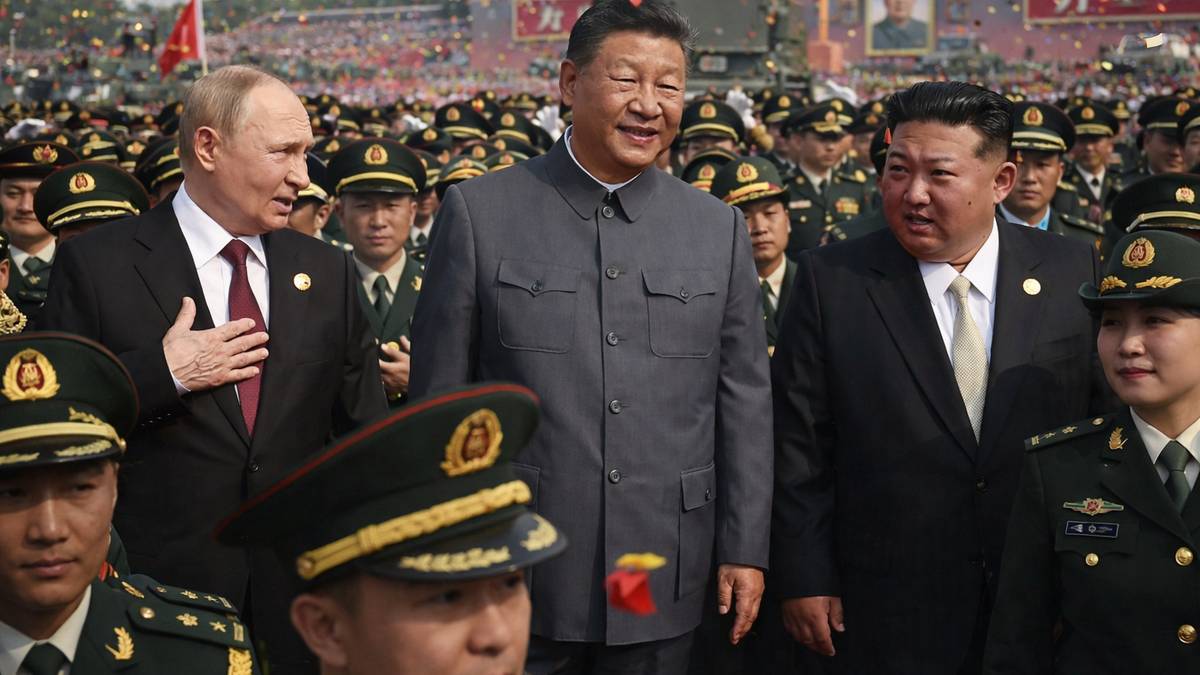
Over the past 3 weeks, Russian oil has emerged through easing sanctions as a key beneficiary of the US-Israeli war on Iran; Pyongyang's importance to Moscow is filling a void in arms supplies; and North Korea's resolve that only a strong, deployed nuclear deterrent can prevent a regime’s collapse has become as poignant as ever. As the White House Deputy Chief of Staff Stephen Millers says, “the real world is governed by strength, it is governed by force, it is governed by power.”
The Thucydides Trap describes a dangerous structural tension when a rising power (China) threatens to displace a ruling nation (U.S.). Since the Peloponnesian War, this tryst has occurred 16 times in the past 500 years and resulted in 12 global conflicts.
Since it’s “Century of Humiliation,” the Middle Kingdom now understands the scope of war — which extends beyond the conventional battlefield to include non-combatant populations, cyber warfare, and economic disruption designed to destroy the enemy's capacity and will to fight — and is cunningly using other’s wars and conflicts to close that gap and achieve the Chinese Dream.

All the World’s a Stage
Make sense of the week's news.
Charlatan reviews the worldview.
CHARLATAN
The Exposé of Politics & Style