CHARLATAN
The Exposé of Politics & Style
New redistricting maps have been proliferating across red and blue states for the past ten months, drawn to benefit political parties in the 2026 United States House of Representatives elections. They are the largest coordinated attempt to redraw congressional districts between decennial censuses in modern American history.
Tit for tat across California, Missouri, North Carolina, Ohio, Texas, Utah, Virginia, and Florida has produced, at present, a wash. But this week's Supreme Court ruling has tweaked the rulebook in a way that could recast the American political landscape.
Writing for the majority in Louisiana v. Callais, Samuel Alito narrows the Voting Rights Act to a single word — intention. "Section 2 challenges must demonstrate that a state intentionally drew new maps to reduce the opportunity of minority voters."
Proving intent in law involves establishing a person's mental state behind an action — achieved through circumstantial evidence, inferred behavior, and statements rather than direct mind-reading. Prosecutors show intent by demonstrating that acts were knowing, willful, reckless, and directly caused the consequences at issue. In practice, the landmark 6-3 ruling struck down Louisiana's second majority-Black congressional district and held that race-conscious redistricting under Section 2 of the Voting Rights Act of 1965 is unconstitutional.
At the center of the ruling lies a chief justice with a cause of his own. As a young lawyer in the Reagan administration, John Roberts criticized the Voting Rights Act's reliance on discriminatory effects rather than discriminatory intent. In internal memoranda, he argued that Section 2 went "beyond" the Constitution by regulating practices that merely resulted in racial disparities. His concern was not the persistence of discrimination, but Congress' aggressive response to it. In Shelby County v. Holder, Roberts wrote that "things have changed in the South," concluding that extraordinary federal oversight was no longer justified.
Unless, of course, you're a former FBI director who has run afoul of the president.
James Comey posted a photo to Instagram in May 2025. In it: seashells arranged on a beach to read "86 47." The Department of Justice indicted him for it this week, arguing that numbers — "86" is a reference to "get rid of," and that "47" is a reference to the 47th president of the United States —constituting a criminal intention to harm the president. Comey maintains the post was a political message, and an exercise of his First Amendment rights to free speech.
The Supreme Court steps in again. Referencing Counterman v. Colorado, prosecutors at the DOJ must prove Comey "had some subjective understanding of the threatening nature of his statements," rather than simply how a reasonable person might interpret them. Because the post is ambiguous, demonstrating that Comey acted "knowingly and willfully" will be, in the estimation of legal observers, a tall burden for the government — given broad First Amendment protections for political speech.
The case is a major test of how recent Supreme Court rulings on "True Threats" apply to cryptic or symbolic political expression. True threats are serious expressions of intent to commit unlawful violence against specific individuals or groups and are not protected by the First Amendment. Counterman changed the legal test from an objective "reasonable person" standard to a subjective one focused on the speaker's mens rea — the standard common law test of criminal liability expressed in the Latin maxim: Actus reus non facit reum nisi mens sit rea. The act is not culpable unless the mind is guilty.
The act is not culpable unless the mind is guilty.
Speaking of which, Charles III became the first British king to address the U.S. Congress on Tuesday, almost 250 years to the day after the United States denounced his fifth great-grandfather as a tyrant and declared its independence. Called a master class in subtle criticism, the speech was received with twelve standing ovations.
He spent decades being told to stay in his lane. As Prince of Wales, Charles was chronically accused of political overreach — letters to ministers, campaigns on architecture, agriculture, alternative medicine, climate. Not to mention the "black spider memos." He was warned, repeatedly, that a king cannot do what a prince can. "The Top Job," Princess Diana told Panorama in 1995, "will bring serious limitations to him. I don't know if he'll be able to adapt to that." Charles acceded to the throne in 2022 and pulled back — until now.
Charles III waltzed into a joint session of Congress and delivered what amounted to a foreign policy address on isolationism, democratic alliances, NATO, Ukraine, environmental action, and the rule of law. That was not the restraint of a constitutional monarch. That was craft. The intent was present, and its deniability was constructed in advance.
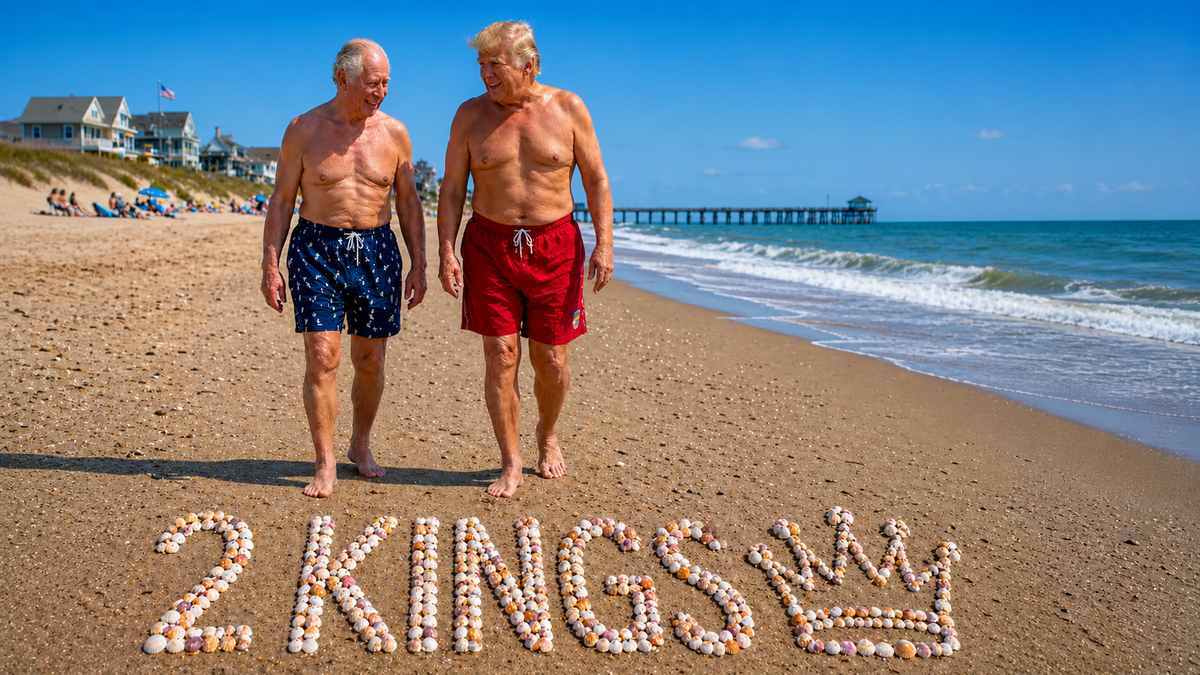
Trump followed suit at the state dinner, and with considerably less subtlety. "King Charles agrees that Iran should not have a nuclear weapon," he told the assembled guests, standing beside a monarch who, by centuries of protocol, could not immediately object. The claim was knowing, willful, and made in front of cameras — hitting every benchmark of mens rea. It was also legally freighted in ways Trump either didn't notice or didn't care to. Under the 1973 War Powers Resolution, a president must terminate hostilities within 60 days unless Congress declares war or extends the deadline. Hostilities in Iran began February 28. A two-week ceasefire followed on April 7. Germany's Chancellor Merz put it plainly: "It's not just about getting in; you also have to get out." Trump's response was to invoke a king's implied endorsement — and to order the withdrawal of 5,000 U.S. troops from Germany. The White House posted a photo of the two men captioned: "TWO KINGS. 👑" Intent, meet evidence.
Buckingham Palace replied with the precision of a surgeon's scalpel — and in doing so, proved the intent of both men. The King, a spokesman said, "is naturally mindful of his government's long-standing and well-known position on the prevention of nuclear proliferation." Adding:
"When we say the King shouldn't get involved in politics, what we mean is that the King shouldn't engage in issues that are politically controversial. But what the King can do, and has done in these speeches, is reflect on where there is consensus."
There it was. Charles knew exactly what he was doing when he walked into that chamber — and had the exit prepared before he sat down. Trump knew exactly what he was doing when he put words in a monarch's mouth — and had the cameras rolling when he did it. Both men acted with intent. Both men walked free.
Which brings us back to the beach, and the seashells, and the dangling question of what James Comey's post actually means.
Actus reus non facit reum nisi mens sit rea. The act is not culpable unless the mind is guilty. By that standard, the man who arranged shells on a beach faces federal indictment. The man who weaponized a king in a toast faces the press. And the king who schooled the United States Congress in the tenets of the Magna Carta — that executive power must be subject to checks and balances — faces the quiet satisfaction that the future of politics lies in soft power. Trump confirms: "He's the greatest king in my book."
He may be right. When George III surrendered the colonies, he told John Adams in 1785: "I was the last to consent to the separation, but will be the first to meet them as friends." Two hundred and fifty years later, his sixth great-grandson walked into a joint session of Congress, delivered a foreign policy address without saying a single political word, received twelve standing ovations, and flew home. The Special Relationship endures — Suez, Vietnam, Iran, tariffs and all.
What matters now — in voting rights, in criminal threats, in the space between a king's word and a president's sword — are the guilty minds on either side of the bench, aisle, and pond.

All the World’s a Stage
Make sense of the week's news.
Charlatan reviews the worldview.
CHARLATAN
The Exposé of Politics & Style