Crossroads to Civilization
In 2008, Charlatan checked into the commercial promise at the W Hotel; sailed to Asia and the Yoros Castle; sweat it out the ambitions in a 300-year-old hammam and investigated Turkey’s formula to success. Charlatan recalibrates how the East reconciled the West.
11 May 2026
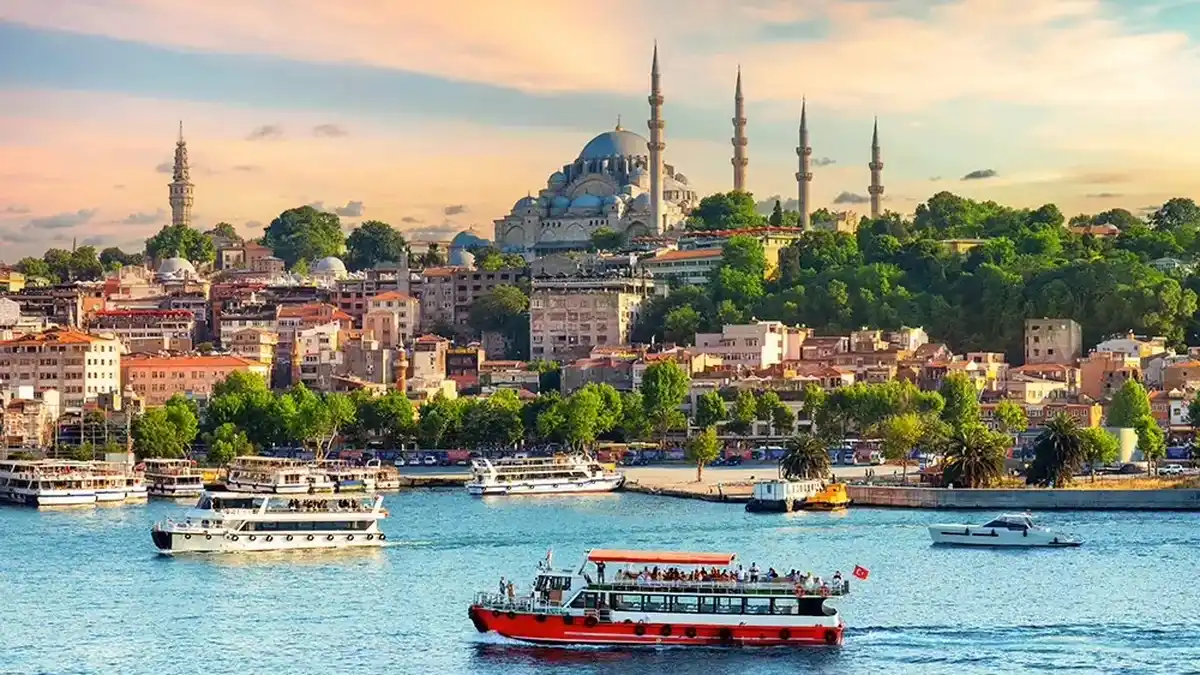
The City That Faces Every Direction In 2008, Istanbul felt like the future. Charlatan returns to find it still does — just not the one anyone predicted.
In the summer of 2008, Istanbul was the most interesting city in the world. Not the loudest, not the richest, not the most powerful — but the most interesting, in the way that only cities standing at the precise hinge of history can be. East and West didn't meet in Istanbul so much as collide, negotiate, and agree to share the same taxi. The Bosphorus ran through the middle of it like a philosophical argument that had been going on for three thousand years and showed no signs of resolution.
We checked into the W Hotel — new then, gleaming, a statement of intent by a city that had decided it was done being underestimated. The W sat in Akaretler, a neighborhood of 19th-century row houses that had been quietly reinvented as one of the city's more fashionable addresses, a ten-minute drive from the ancient city and a world away from it in temperament. The rooms were sleek. The bar was louder than a Byzantine council. The rooftop looked out over the Bosphorus as though the city were showing off, which it was.
Istanbul in 2008 was a city in the middle of a remarkable act of reinvention. The economy was growing. Tourism was surging. The European Union accession process — hopeful, improbable, already showing cracks — was still technically alive. Recep Tayyip Erdoğan's AKP had been in power for six years, and the dominant Western narrative was cautiously optimistic: a moderate Islamist party governing a secular democracy, threading the needle between mosque and marketplace, East and West. A model, some said. A formula for something.
We did not spend our days at the W. Istanbul does not permit that kind of passivity.
Topkapi Palace demanded a full morning and took two. Perched on the promontory where the Bosphorus meets the Golden Horn and the Sea of Marmara, the palace was the nerve center of the Ottoman Empire for four centuries — home to sultans, harems, holy relics, and enough emeralds to make a reasonable person reconsider their life choices. In 2008 it was a museum, the Ottomans having been considerate enough to fall from power before the age of Instagram. The rooms were dense with consequence: the Throne Room, the Imperial Treasury, the sacred relics of the Prophet. Outside, the gardens looked out over three bodies of water simultaneously, which felt appropriate for a city that had always faced in multiple directions at once.
The Çağaloğlu Hammam was the corrective. Built in 1741 — the last great bathhouse of the Ottoman era, constructed to fund the library of Sultan Mahmud I — it stands fewer than two hundred meters from Topkapi, in the heart of Sultanahmet, unchanged in the way that only things deeply confident in their own purpose can be. Florence Nightingale came here. Kaiser Wilhelm II. Franz Liszt. Harrison Ford. The guest list spans three centuries and several contradictions, which is also Istanbul's gift. You entered through grand domed rooms, marble floors worn smooth by three hundred years of bare feet, steam rising from the central göbek taşı — the navel stone — the heated marble slab at the heart of the bath where you surrendered whatever tension you had arrived with to an attendant who had no interest in your opinions about it. The heat was absolute. The silence was instructive. The Ottomans understood that civilization requires, periodically, the complete evacuation of the ego.
From Topkapi we sailed across the Bosphorus. It takes twenty minutes by ferry. In those twenty minutes you cross from Europe into Asia, from one continent to another, from the western shore of one of history's great arguments to its eastern bank. Istanbul is the only city in the world that can make that claim. The Asian side — quieter, more residential, less performed — felt like a different city sharing the same name. At Anadolu Kavağı, near the mouth of the Black Sea, the ruins of Yoros Castle watched over the strait from a limestone promontory. Byzantine walls, Genoese repairs, Ottoman additions — the castle was a palimpsest of every civilization that had understood what controlling this waterway meant. Standing at the top, with the Black Sea opening to the north and the Bosphorus narrowing behind you, it was possible to understand, in the way that only geography can teach, why Istanbul has always been fought over. It was not a city. It was a lock on a door that the whole world wanted to open.
That was 2008. Istanbul was becoming. Turkey was a story in progress, and the dominant narrative was still reasonably hopeful.
The story has since revised itself.
Erdoğan did not thread the needle between mosque and marketplace. He chose. Over eighteen years, the democratic opening of the early AKP era — the EU ambitions, the judicial reforms, the tentative press freedoms — was systematically dismantled and replaced with something harder and more personal. Journalists imprisoned. Opposition mayors arrested. Elections engineered with sufficient theatrical opposition to generate turnout but never enough to produce a result Erdoğan didn't control. Topkapi, the museum we walked through in 2008, became a political symbol in 2020 when Erdoğan converted Hagia Sophia — the great Byzantine basilica visible from Topkapi's gardens — back into a mosque, a gesture aimed less at the faithful than at the audience watching from Brussels and Washington.
Then came the Iran War.
When the United States and Israel launched strikes on Iran in February 2026, Turkey's position became the geopolitical equivalent of standing in the middle of a six-lane highway. Turkish leaders condemned U.S. and Israeli strikes on Iran while simultaneously warning Tehran against expanding the conflict — a delicate strategy of hedging between competing interests. Erdoğan declared that Turkey had no desire to be drawn into the war, positioning himself instead as a peacemaker, portraying Turkey as an advocate of regional stability and Israel as a warmonger manipulating the United States into attacking Tehran. NATO intercepted Iranian missiles crossing Turkish airspace. Erdoğan condemned the strikes and offered condolences for the death of Khamenei. He also kept Incirlik Air Base — one of the U.S. military's most critical regional assets — open and operational. AllianzHkeconomy
This is the acrobatics of Erdoğan's Turkey in 2026. A NATO member that continues leaning into the alliance for its security while aligning, de facto, with revisionist powers Russia and China on questions of global order. A country that hosts twenty-five American and NATO bases while its president calls Israel a terrorist state and compares Netanyahu to Hitler. A careful navigator maintaining neutrality and geopolitical balance even as the conflict has spread across countries from the Indian Ocean to the European Union. It is, depending on your perspective, either remarkably sophisticated foreign policy or the most elaborately sustained hedge in modern diplomatic history. ASEAN+3 Macroeconomic Research OfficeForeign Policy
What it is not is the Turkey of 2008. The city that felt like a hinge — between East and West, between secular and sacred, between democratic aspiration and imperial memory — has become something more ambiguous and more consequential. It is no longer becoming. It has arrived at something. The question is what to call it.
The Çağaloğlu Hammam still stands. The steam still rises from the navel stone. The Bosphorus ferry still crosses in twenty minutes, Europe giving way to Asia with the unhurried confidence of a geological fact. Yoros Castle still watches over the strait where the Black Sea begins, its Byzantine stones indifferent to whoever currently controls the argument.
Istanbul does not change. It accumulates. Every civilization that thought it had finally resolved the city's meaning added another layer to the walls and moved on, and the city absorbed the addition and continued doing what it has always done — standing at the hinge of everything, facing every direction at once, belonging fully to none of them.
Erdoğan will pass. The geopolitics will shift. The W Hotel will redecorate. And Istanbul will still be there at the intersection of three bodies of water, the most interesting city in the world, waiting for the next civilization to arrive and discover that it cannot be resolved either.