CHARLATAN
The Exposé of Politics & Style

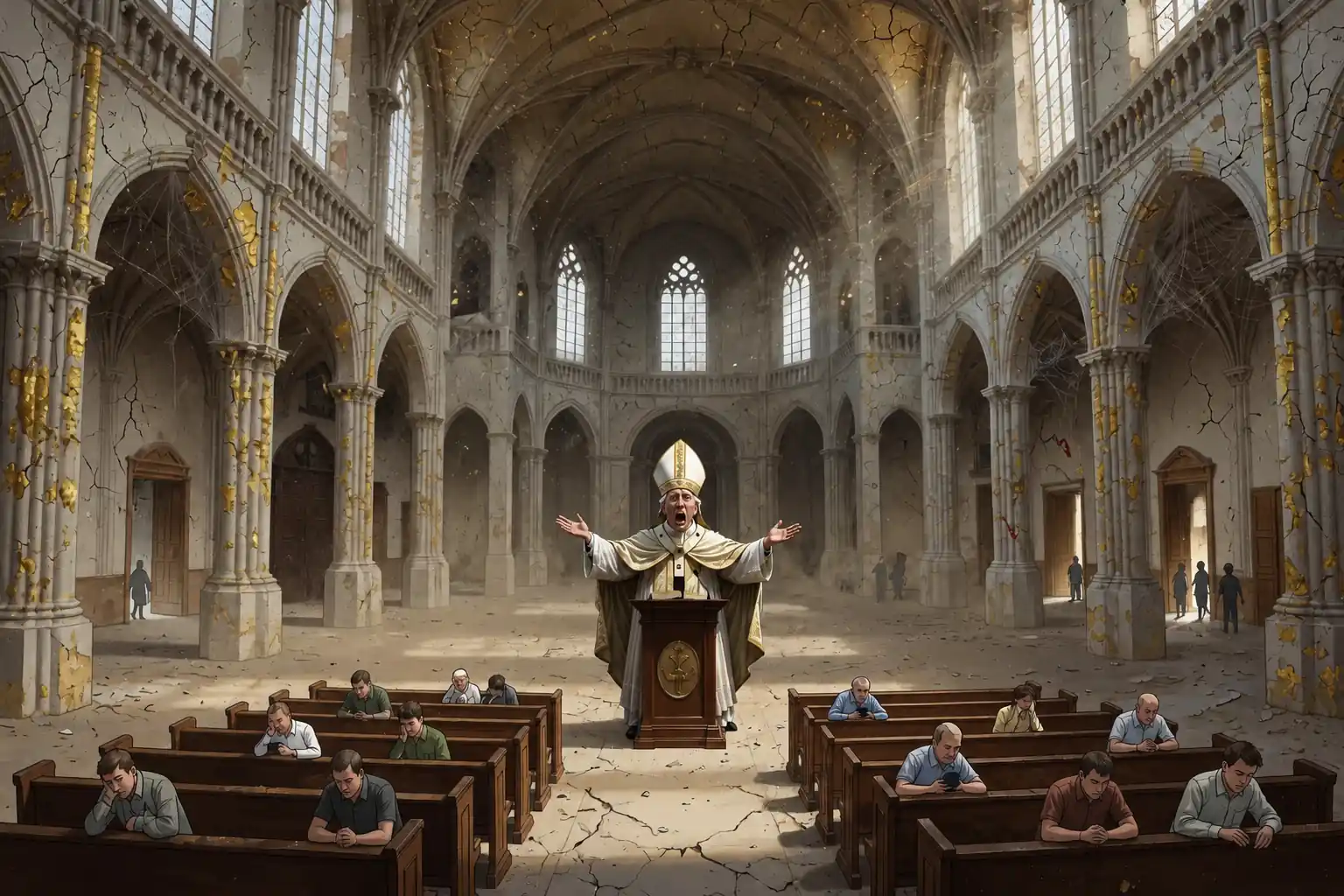
Indulge me this week as I play fictional Wall Street analyst to a very real—and very troubled global enterprise. The good news? This outfit adds 50,000 new members every year in sub-Saharan Africa, the poorest in the world. The bad news? It is hemorrhaging market share everywhere that actually pays the bills. In the United States, its richest territory, net losses run around 350,000 members a year. Weekly engagement sits at just 17% of the membership they claim to have. The talent pipeline has collapsed 97% — from 122 seminary training programs to three, according to The Center for Applied Research in the Apostolate (CARA). Western Europe has become a rounding error. Latin America, once a bulwark, is defecting quietly but steadily to evangelical competitors. Looming liabilities include hundreds of millions set aside to settle clergy abuse lawsuits that show no signs of abating.
Which failing firm is this? Sears? Bed Bath & Beyond? Wachovia? Enron? No — it’s the Roman Catholic Church. But here’s the irony: it can never go bankrupt. My final stock rating shortly.
THE CEO DIES. THEY PICK... WHO??
When a long-serving CEO dies, the Board usually reaches for the known quantity. Battle-tested. Street Cred. That is not what happened here. Pope Francis — beloved by half the Church, despised by the other half — died in April 2025. The Conclave deadlocked on the usual suspects. On the fourth ballot, they surprised everyone. Robert Francis Prevost wasn’t on anyone’s shortlist. Or their long list. They chose a Chicago-born Augustinian friar who had spent most of his adult life in quiet obscurity in Peru. He took the name Leo XIV.
Questions that nobody has fully answered: Why him? Why an American? Why now?
Three theories present themselves, and the honest answer is probably all three at once.
Theory One: The Seat Filler. White smoke announced Prevost after a fourth ballot — not because anyone loved him but because none of the rival factions hated him. A caretaker. Except nobody shared with him this job description.
Theory Two: The Donor Appeal. The United States remains the Church’s financial lifeline even as it bleeds members. An American Pope was the Hail Mary play to protect the Fatted Calf.
In 57 AD, the Apostle Paul faced a similar challenge: appealing to the wealthy Roman church to fund his mission to Spain. Fourteen chapters of flattery before the ask arrives. A pitch deck to donors he’d never met, written by a man who understood you don’t lead with the invoice. Leo XIV appears to be running the same two-millennia-old playbook. Early returns are mixed — the conservatives Rome needs most are not impressed.
Theory Three: Institutional Drift. Pope Francis spent his pontificate emphasizing open borders, climate activism, and economic redistribution in tones that often sounded closer to Davos than Doctrine. His successor has picked up the same script — denouncing nationalism and unregulated capitalism on the world stage. Two consecutive pontificates pursuing the same global policy agenda. The Vatican didn’t wander toward progressive globalism by accident. It was invited.
THE TWEETS, THE POPE, AND THE CULTURAL CLIFF
Our new American Pope wasted no time. Within weeks he was publicly calling out the hypocrisy of politicians who claim to be pro-life while endorsing what he called “inhuman treatment of immigrants.” He didn’t name Trump because it was obvious who was targeted.
Trump posted not one but two AI-generated images — himself enthroned as a medieval Pope, or perhaps Jesus himself, and a second depicting him alongside a defeated, cowering Leo. Both went viral. Some Catholics winced. The more honest read? Trashing the Pope barely registered as a scandal. When called out on the Jesus image he deleted it and claimed it was actually a Red Cross doctor. A shrug, a meme, a news cycle.
Contrast this to 1992. Sinead O’Connor protested the Catholic Church sex abuse scandal on Saturday Night Live by tearing up a photo of Pope John Paul II and saying “fight the real enemy.” It ended her career overnight. At her next appearance, she was booed off stage at Madison Square Garden. Sinead would never be the same. One gesture aimed at the Vatican. A protest everyone privately agreed with. Cancelled. Mostly forgotten and dead at 56.
Thirty-four years later a sitting President posts himself as the Pope twice in a week and it’s a Thursday. That’s not Evolution. That’s a Cultural Cliff. And only Cliff Huxtable has fallen harder in this era than the Pope.
THE ORIGINAL LEO, THE SALESMAN, AND THE KABUKI
To understand his new name, we need to understand the man behind it. Leo XIII carefully styled himself as a modernizing rebel. In 1891, he published Rerum Novarum attacking both robber-baron capitalism and godless socialism — a document theologians still cite as a cornerstone of Catholic social teaching. Cynics say it was nothing more than a Copy/Paste on 100 years of the labor movement, “borrowing” from Adam Smith, Saint-Simon, Marx, Engels. Today, the impact is negligible and the document largely unknown. He followed it with 85 more encyclicals which gathered dust. In Analyst terms: maximum output, zero market impact.
Now comes Leo XIV — the new rebel Pope, Hollywood central casting edition. An American. A Reformer. A man who picks a fight with the most powerful person on earth within weeks. And on May 15 — the 135th anniversary of his namesake’s masterwork — he publishes his own treatise on AI, human dignity, and the concentration of power, Magnifica Humanitas. At 42,000 words, it is already being shrunk, packaged and flash-frozen for easy delivery to parishes. How many will microwave and serve is in question.
Media coverage. Zero policy outcomes. Sound familiar? It will certainly follow Rerum Novarum into the same respectful, dusty obscurity.
For the first time in church history, the Pope personally presented his own encyclical rather than delegating to cardinals. Standing next to him: Christopher Olah, co-founder of Anthropic, known primarily for his interpretability work. A self-proclaimed Atheist. A Salesman.
Why exactly was Anthropic invited? According to Claude, Anthropic’s own AI engine: absolutely nothing was provided. No deal, no product, no contract. A handshake. A photo.
I’m not believing it’s a coincidence that Anthropic is embroiled in a lawsuit with the Trump administration. They were recently labeled by Pete Hegseth a national security risk after refusing Pentagon demands to enable autonomous weapons and mass surveillance.
The missive is substantive. The theater around it was pure kabuki. Rome got the Headline. Anthropic got the Photo Op. Washington got the Finger.
TOO BIG TO FAIL
The Kabuki is over. Back to the ledger.
This phony Financial Analyst has completed his due diligence. The numbers are damning. Only one new impoverished member to replace each 12 wealthy members lost. Management’s response to the collapse? Press releases and photo ops. A CEO who confuses activism with strategy. A Board that mistook a handshake with a Silicon Valley Atheist for a turnaround plan.
The drift toward Davos and progressive politics isn’t saving the Church. It’s accelerating the estrangement from the one demographic that still fills the Collection Boxes. Leo’s early rhetoric lands as a direct shot at American conservatives. You cannot simultaneously lecture your members and expect their loyalty. That’s not theology. That’s just bad business.
The AI encyclical will be forgotten. The Anthropic photo op will be a footnote. Leo XIII published 86 documents that changed almost nothing. Leo XIV is on pace to match him.
The Church is not going bankrupt. The fortress is too deep, the accumulated wealth too old, the real estate too vast. An institution can be simultaneously insolvent and immortal — sustained by assets accumulated over millennia while its operational core quietly hollows out around them.
But a pyrrhic victory is still a loss.
So where does that leave the long-term investor?
FINAL RATING: UNDERPERFORM.
There’s lots to like about a trillion dollar, tax-exempt organization. Yet cash flows are dwindling. Even a 2,000-year-old icon needs butts in the pews to run it on. And the new CEO’s turnaround plan isn’t filling them.
Institutions like this don’t go bankrupt. They drift.
Like Sears—once an indestructible American blue chip—the Roman Catholic Church retains the illusion of inevitability while its core business quietly erodes. The fortress may never fall. But that doesn’t mean it’s winning.
As You Like It
The Week's Stocks, Risks,
Tips & Tricks on Wealth
CHARLATAN
The Exposé of Politics & Style